

Business Operation · 2025
In this section22 topics
- Corporate Information4 items
- Dividend Policy2 items
- Major Shareholders1 item
- Business Strategies Overview5 items
- Material Changes & Developments1 item
- Use of Proceeds from Securities Offerings1 item
- Commitments Made in the Registration Statement1 item
- Group Operating-Structure Policy1 item
- Companies Where the Company Holds ≥10%1 item
- Shareholders with Potential Conflict of Interest1 item
- Relationships Among Major Shareholders1 item
- Shareholders' Agreement1 item
- Shareholding Diagram (Group Structure)3 items
- Income Structure3 items
- Product / Service Characteristics2 items
- Research & Development6 items
- Assets Used in the Business6 items
- Marketing Policy & Competition5 items
- Procurement of Products & Services2 items
- Projects Under Construction1 item
- Debentures & Bills of Exchange1 item
- Convertible Securities1 item
Corporate Information
Company Name
ASIA BIOMASS PUBLIC COMPANY LIMITED
Telephone
0-2415-0054
Website
www.asiabiomass.com
ir@asiabiomass.com
Dividend Policy
Dividend Policy
The Company has a policy to pay dividends at a rate of not less than 40% of net profit after corporate income tax and after deducting all types of reserves as required by law and as stipulated in the Company's Articles of Association. The Board of Directors is authorized to approve the consideration of dividend payments, taking into account various factors for the benefit of shareholders, such as reserves for loan repayments, investment plans for business expansion, or to support the Company's cash flow in the event of market condition changes, among others. Resolutions of the Board of Directors regarding such matters must be approved by the shareholders' meeting, except for interim dividend payments, which the Board of Directors is authorized to approve, and subsequently report to the shareholders' meeting at the next meeting.
Historical Dividend Payments
| This Year | Last Year | 2 Years Ago | 3 Years Ago | 4 Years Ago | Metric | Description |
|---|---|---|---|---|---|---|
| 0 | 0 | 0 | 0 | 0 | Net profit per share (Baht : Share) | Net profit per share (baht : share) |
| 0 | 0 | 0 | 0 | 0 | Dividend per share (Baht : Share) | Dividend per share (baht : share) |
| 0 | 0 | 0 | 0 | 0 | Dividend stock ratio (Number of original shares: dividend shares) | Ratio of stock dividend payment (existing share : stock dividend) |
| 0 | 0 | 0 | 0 | 0 | Dividend share value per share (Baht : Share) | Value of stock dividend per share (baht : share) |
| 0 | 0 | 0 | 0 | 0 | Total dividend payment value (Baht : Share) | Total dividend payment (baht : share) |
| 0 | 0 | 0 | 0 | 0 | Dividend payout ratio to net profit (%) | Dividend payout ratio compared to net profit (%) |
Business Strategies Overview
Chairman's Message
Dear Shareholders,
In 2025, the biomass energy business faced challenging and volatile market conditions, particularly due to rising raw material prices and transportation costs driven by the global economic situation. However, the Board and management have not been complacent and have used this period to accelerate internal business restructuring to strengthen and prepare for long-term growth.
To manage volatility and maintain the company's profit margins, the Board has focused on rigorous cost management strategies as follows:
Enhancing procurement efficiency : Developing a diversified and flexible raw material sourcing system to reduce reliance on traditional sources.
Proactive pricing policy : Adjusting the sales price structure to reflect the true cost and quality of biomass fuel (Quality-Based Pricing) to ensure fairness for all parties and create revenue stability for the company.
Outlook and Vision for 2026 For 2026, the company sees clear opportunities from the global transition to clean energy. Biomass energy will remain a crucial piece in reducing reliance on fossil fuels, especially in Asia, where the demand for renewable energy is continuously increasing. The company is committed to becoming a "Sustainable Energy Flagship" by focusing on increasing the proportion of high-value products and expanding export markets. By utilizing technology to enhance production efficiency, the Board is confident that the planned performance recovery and aggressive market expansion will generate stable and sustainable returns for all shareholders. Finally, on behalf of the Board of Directors, we would like to thank our shareholders, business partners, and all employees for their collective efforts in overcoming challenges and for moving forward together towards success in 2026.
Vision
To be a leader in biomass and related goods procurement and development in ASEAN, with solutions that meet customers' needs in various industries and be ready to focus and drive the business to grow sustainably based on the new economy (BCG Economy)
Objectives
Response promptly to customers’ needs with various biomass fuels, focuses on quality and quantity of biomass fuel are delivered to customers continuously and regularly, with a logistics system that satisfied, including excellent after-sales service and considering the interests of the Company's stakeholders
Goals
Under the current economic conditions and climate crisis, the company recognizes that profit growth alone is insufficient for long-term business leadership. Therefore, the company has set strategic goals focused on value creation for the business and all stakeholders, as follows :
1. Building Competitiveness and Performance Excellence
The company is committed to upgrading its capabilities with clear commercial goals, including revenue targets, increased profitability, and operational excellence.
2. Ethical Business and Stakeholder Responsibility
The company is committed to good corporate governance to build trust among shareholders and all stakeholders. This includes:
Transparency : Adjusting pricing policies to fairly reflect true quality and costs (Fair Pricing).
Stakeholder rights and responsibilities to shareholders.
Business ethics : Freedom from corruption at every stage of procurement and strict adherence to laws and regulations.
3. Social & Environmental Value
The biomass business is at the core of the transition to a low-carbon
Society Community development : doing CSR activities around the factory
Reducing environmental impact : focusing on the management of agricultural waste and materials. (RDF) Convert to Energy to Reduce Outdoor Combustion, which Causes PM 2.5 Dust and Reduce Waste Accumulation
Reducing Greenhouse Gas Emissions : Supporting Industry Group Customers to Reduce Fossil Fuel Use to Achieve National Net Zero Goals
4. Resilience & Adaptability. The company designs its business structure to be agile to cope with unpredictable external factors :
Raw material risk management : develop an active procurement system and expand its strategic partner network. (Strategic Partners) to create raw material stability even in the face of fluctuating prices
Sealing is underway with the Group (Synergy): leveraging the shared logistics infrastructure. To enhance the ability to adapt to transportation costs
Market expansion: closely monitor renewable energy trends in Asia, to expand export markets and adjust cargo ports in line with changing global market needs.
The company believes that these four goals will enable it to grow steadily under a strong business ethics, create stability, and play a vital role in caring for society and the planet sustainably.
Business Strategies
Short-term strategy Adapting to short-term challenges to ensure a stable recovery in performance, we focus on rigorous cost management and improved raw material procurement efficiency. In addition, the company has adjusted its pricing policy to reflect the true cost and quality of biomass fuel (Quality-Based Pricing) in order to maintain an appropriate profit margin.
Strategy for 2026 : Aiming to be the "Sustainable Energy Flagship"
In 2026, the company is ready to move forward with its key strategy to elevate the organization to become the Sustainable Energy Flagship of the group, targeting revenue of 2,000 – 2,500 million baht through the following main operational plans :
Increasing product value : Focusing on increasing the proportion of high-value biomass products and reducing risks from traditional trading business.
Financial management : Increasing the efficiency of working capital to significantly reduce financial costs.
Synergy : Integrating logistics with the group to gain a cost and transportation advantage.
Expanding the business base : Focusing on growth in wood pellets and RDF (Refuse Derived Fuel) products by investing in modern machinery to increase production efficiency.
Expanding into international markets : Expanding the export market base for wood chips and other agricultural products, including joint ventures with strategic partners to further develop the business in the long term.
Long-term business strategy
Future vision The company believes that the trend of renewable energy use in the Asian region will continue to grow, especially biomass energy, which plays a crucial role in the transition from fossil fuels to clean energy. The company is exploring investments in businesses related to the biomass value chain to increase product value and create long-term growth.
Material Changes & Developments
Material Changes & Developments
| Year | Description |
|---|---|
| 2,022 |
|
| 2,023 |
|
| 2,024 |
|
| 2,025 |
|
Use of Proceeds from Securities Offerings
Is There Money Raised from a Securities Offering Still to Report On?
No
Commitments Made in the Registration Statement
Are There Commitments or Conditions from an Offering or Listing?
No
Group Operating-Structure Policy
Description
To ensure clarity and transparency in the Group's business operations, prevent conflicts of interest between the Company and its subsidiaries, and build confidence among all stakeholder groups, the Company maintains fair management practices that serve the Company's best interests. The Company has established guidelines for segregating operations within the Group, based on the following criteria:
1. Measures to Prevent Internal Competition to avoid the transfer of business opportunities.
Non-Compete Clause: Directors and executives of the Company shall not engage in businesses of the same nature that compete with the Company's business, whether for their own benefit or that of others.
2. Pricing for Intercompany Transactions. The Company establishes a policy for pricing goods and services between the Company, its subsidiaries, and related parties, based on the principle of reasonableness and fairness, as if transacting with external counterparties. Detailed pricing criteria are provided according to transaction type.
3. Management of Intercompany Transactions. In the event of transactions between companies within the Group, the following principles shall be adhered to:
Normal Commercial Terms: Prices and conditions must be equivalent to transactions with external parties.
Approval Process: Must be reviewed by the Audit Committee to provide an opinion on reasonableness, and no interested parties shall participate in the decision-making.
Disclosure: Disclose details of intercompany transactions in the annual information statement, in accordance with SEC criteria.
4. Supervision of Subsidiaries
Appointment of Representatives as Directors: Appoint individuals to serve as directors in subsidiaries to oversee business direction.
Approval Authority Regulations: Define the scope of decision-making authority for subsidiaries, whereby significant items (e.g., new investments, sale of major assets) must receive prior approval from the parent company's Board of Directors.
Internal Control System: Establish accounting and internal control systems for subsidiaries that align with the parent company's standards to enable timely data collection and preparation of consolidated financial statements.
Companies Where the Company Holds ≥10%
Companies (≥10% Holding)
| Company Name | Address | Province | Zip Code | Telephone | Business Type | Security Type | Shares | Paid-up Shares |
|---|---|---|---|---|---|---|---|---|
| Praprapas Company Limited | 99/9 Rama II Road, Samae Dam Sub-district, Bang Khun Thian District | Bangkok | 10150 | 0-2415-0054 | Procurement and distribution of VAT-exempt biomass fuel | Common shares | 10,000 | 10,000 |
| Sathaporn Thanapat Company Limited | 99/9 Rama II Road, Samae Dam Sub-district, Bang Khun Thian District | Bangkok | 10150 | 0-2415-0054 | Provide road freight services | Common shares | 40,000 | 40,000 |
| Alpha G Venture Company Limited | 99/9 Rama II Road, Samae Dam Sub-district, Bang Khun Thian District | Bangkok | 10150 | 0-2415-0054 | Investment in other non-financial businesses | Common shares | 3,100,000 | 3,100,000 |
| Green RDF Company Limited | 99/9 Rama II Road, Samae Dam Sub-district, Bang Khun Thian District | Bangkok | 10150 | 0-2415-0054 | Production and distribution of refuse-derived fuel | Common shares | 335,500 | 335,500 |
| Asia Biomass Energy SDN. BHD. | Wisma Destiny, Sublot 47, Parent Lots 3485 & 3064, Parkcity Commerce Square, Jalan Tun Ahmad Zaidi, 97000 Bintulu, Sarawak, Malaysia | Foreign country | 0-2415-0054 | Biomass fuel procurement | Common shares | 3,246,829 | 3,246,829 | |
| Asia Biomass Resources SDN. BHD. | Wisma Destiny, Sublot 47, Parent Lots 3485 & 3064, Parkcity Commerce Square, Jalan Tun Ahmad Zaidi, 97000 Bintulu, Sarawak, Malaysia | Foreign country | 0-2415-0054 | Biomass fuel procurement | Common shares | 2,304,865 | 2,304,865 | |
| QTC Energy Public Company Limited | 2/2 Soi Krungthep Kreetha 8 Yaek 5, Krungthep Kreetha Road, Huamark Subdistrict, Bangkapi District | Bangkok | 10240 | 0-2379-3089-92 | Production of Electrical Transformers | Common shares | 341,092,557 | 341,092,557 |
Income Structure
Product / Service Income
| Category | Description | This Year | This Year % | Last Year | Last Year % | 2 Years Ago | 2 Years Ago % |
|---|---|---|---|---|---|---|---|
| Total revenue from operations | Total revenue from operations | 2,027,615 | 100 | 2,591,431 | 100 | 2,391,480 | 100 |
| Palm Kernel shell | 463,016 | 22.84 | 957,484 | 36.95 | 1,127,180 | 47.13 | |
| Woodchip and other parts of wood | 1,209,792 | 59.67 | 1,275,321 | 49.21 | 900,201 | 37.64 | |
| Biomass Pellets | 231,158 | 11.4 | 208,736 | 8.05 | 292,670 | 12.24 | |
| Wood Shavings, Sawdust and Wood dust | 19,044 | 0.94 | 32,822 | 1.27 | 27,560 | 1.15 | |
| RDF | 77,803 | 3.84 | 77,290 | 2.98 | 14,217 | 0.59 | |
| Other products | 2,482 | 0.12 | 13,719 | 0.53 | 10,611 | 0.44 | |
| Transportation services | 5,430 | 0.27 | 26,059 | 1.01 | 19,041 | 0.8 | |
| Other | Other | 18,890 | 0.93 | 19,391 | 0 | 6,111 | 0 |
Export Income
| Category | Description | This Year | This Year % | Last Year | Last Year % | 2 Years Ago | 2 Years Ago % |
|---|---|---|---|---|---|---|---|
| Total revenue | Total revenue from operations | 2,027,615 | 100 | 2,591,431 | 100 | 2,391,480 | 100 |
| Domestic | Domestic | 1,161,553 | 57.29 | 1,070,361 | 41.3 | 1,721,300 | 71.98 |
| International | International | 866,062 | 42.71 | 1,521,070 | 58.7 | 670,180 | 28.02 |
Other Income
| Operating Other Income | Non-Operating Other Income | Share of Profit |
|---|---|---|
| 1710 · As of year: 10944.08 · Description: Total other income · As of yesteryear: 17336.98 · As of year before yesteryear: 5429.25 · 1711 · As of year: 0.0 · Description: Other income from operations · As of yesteryear: 0.0 · As of year before yesteryear: 0.0 | 1712 · As of year: 10944.08 · Description: Other income not from operations · As of yesteryear: 17336.98 · As of year before yesteryear: 5429.25 | 1713 · As of year: 6927.8 · Description: Share of profit · As of yesteryear: 27188.56 · As of year before yesteryear: 21444.79 |
Product / Service Characteristics
Business Type
3114
Business Groups
| Business Group | Description |
|---|---|
| Palm Kernel Shell | Palm kernel shell (“PKS”) is one of the components of the oil palm fruit. It is located between the palm fibre attached to the outermost shell and the palm kernel at the innermost part. In general, palm kernel shell is brown in colour and has a hard texture. In the palm oil production industry, palm kernel shell remains after the extraction of palm oil and is regarded as a biomass fuel with a high calorific value. At present, palm kernel shell is widely used by industrial plants as an alternative fuel to replace high-priced fuel oil. Consequently, the domestic supply of palm kernel shell is insufficient to meet market demand, resulting in imports from foreign countries such as Indonesia and Malaysia. Basic specifications are as follows:
|
| Woodchip and Others | Biomass fuel is produced from hardwood sourced from wood processing plants, such as wing slabs, or from rubber plantations owned by farmers, such as firewood, under sustainable forest plantation management practices in compliance with international standards. The raw materials are then processed into woodchips of approximately 1–2 inches in size, making them suitable for use in boilers to achieve efficient combustion. The woodchip products and other wood-based products distributed by the Company and its subsidiaries include woodchips, wing slabs, log tops, and other wood residues obtained from cutting and sawing processes at sawmills, woodchip manufacturing plants, wood processing factories, and wooden furniture factories. These products vary in size depending on customers’ usage requirements. The woodchip products and other wood-based products distributed by the Company and its subsidiaries are sourced from rubberwood and 13 species of wood permitted by the Royal Forest Department. Basic specifications are as follows:
|
| Wood Pellets | Wood pellets, or densified biomass fuel, are an innovative biomass fuel in the form of solid fuels. They are produced from hardwood obtained from farmed trees under sustainable forest plantation management practices in compliance with standards established by internationally recognized forest management organizations. Wood pellets provide a high calorific value and serve as a clean renewable energy fuel, replacing fossil fuels. Their use helps reduce carbon dioxide (CO2) emissions, mitigate environmental impacts and global warming, and support sustainable development in the industrial sector and human livelihoods. Biomass pellets are products derived from by-products of agricultural processing, such as bark, other wood residues, wood shavings, sawdust, and rice husks, which are processed through size reduction, moisture reduction, and compression into small cylindrical pellets. Due to the compression and heat applied during the production process, biomass pellets have high density and low moisture content, resulting in a higher calorific value than biomass fuel before pelletisation. The biomass pellet products distributed by the Company and its subsidiaries are mainly produced from wood by-products, such as wood shavings and sawdust, commonly referred to as wood pellets. In addition, the Company and its subsidiaries also distribute other types of biomass pellets, such as rice husk pellets and mixed sawdust-rice husk pellets. Basic specifications are as follows:
|
| Wood chip Eucalyptus | Eucalyptus woodchips, or eucalyptus chips, are produced from eucalyptus logs. In the past, trees used for paper production were commonly harvested from natural forests. At present, however, the trees commonly used in paper production are pulpwood trees, which are improved varieties derived from eucalyptus and cultivated by farmers, typically along paddy field boundaries. The trees used for paper production are generally harvested at approximately 3–5 years of age. They are cut into logs or log-like sections and then undergo a debarking process to obtain debarked logs, which are subsequently fed into woodchipping machines and processed into small chips for use in pulp production. Basic specifications are as follows:
|
| Wood Shaving/ Sawdust | Wood Shaving This biomass fuel is obtained from solid wood furniture factories. It has low moisture content and a high calorific value, making it suitable for use in boilers in industrial plants. It is also in high demand as it is a key raw material used in the production of wood pellets. The product is a by-product derived from wood processing and is characterized as thin bark-like wood pieces obtained from the wood processing operation. Basic specifications are as follows:
Sawdust Biomass fuel obtained from wood processing plants (sawmills) is suitable for use in boilers in industrial plants and is also used as a raw material for the production of wood pellets. Basic specifications are as follows:
|
| Refuse Derived Fuel (RDF) | Refuse-derived fuel (“RDF”) is a type of solid fuel produced by improving the chemical and physical composition of municipal solid waste through various processes, such as size reduction, separation of combustible waste from organic waste, metal scraps, non-combustible waste and other waste, densification, moisture reduction, and other treatment processes. These processes are intended to produce RDF with improved quality and properties, such as calorific value, size, moisture content and density, suitable for use as fuel for the generation of electrical energy or thermal energy, or for co-firing with coal in order to reduce coal consumption. Types of refuse-derived fuel (RDF)
|
Research & Development
Has R&D Policy (Y/N)
No
R&D Cost — Description
During the past three years, the Company has not incurred any research and development expenses, as the nature of its business primarily focuses on the sourcing, production, distribution, and related services of biomass fuel, and does not involve any significant direct research and development activities.
R&D Cost — Label
Research and development (R&D) expenses over the past 3 years (Million Baht)
R&D Cost — This Year
0.0
R&D Cost — Last Year
0.0
R&D Cost — 2 Years Ago
0.0
Assets Used in the Business
Permanent Assets — Description
As at 31 December 2025, the details and net book values, after accumulated depreciation, of the principal fixed assets used in the business operations of the Company and its subsidiaries (hereinafter collectively referred to as the “Company”), as presented in the Company’s consolidated financial statements, are summarised as follows:
Permanent Assets — Appraisal
| Asset | Ownership | Obligation | Appraisal Value | Description |
|---|---|---|---|---|
| Land and Land improvements | Owned by the Company | The Company pledged its land and land improvements as collateral for credit facilities. | 407,796,010 | The Company pledged a portion of its land and land improvements with a book value of THB 387.71 million as collateral for credit facilities obtained from financial institutions. |
| Building and structures | Owned by the Company | The Company pledged its building and structures as collateral for credit facilities. | 57,872,701 | The Company pledged a portion of its building and structures with a book value of THB 14.19 million as collateral for credit facilities obtained from financial institutions. |
Intangible Assets — Description
As at 31 December 2025, the items and net book value, after deducting accumulated amortisation, of the intangible assets used in the business operations of the Company and its subsidiaries (hereinafter collectively referred to as the “Company”), as presented in the consolidated financial statements of the Company, amounted to THB 3.33 million.
Intangible Assets — Appraisal
| Asset | Type | Appraisal Value |
|---|---|---|
| Intangible assets | Software | 3,328,302 |
Has Subsidiaries Investment Policy (Y/N)
Yes
Subsidiaries Investment Policy — Description
The company has formulated investment and management policies for its subsidiaries and affiliated companies. The company will invest in businesses related to or beneficial to the company's operations to improve its stability and business performance.
In addition, in order to supervise the operations of its subsidiaries and affiliated companies, the company should dispatch company representatives with qualifications and experience suitable for the company's investment business to serve as directors of its subsidiaries and affiliated companies. The representative may be the Chairman of the Board, CEO, director, senior management, or any person who has no conflict of interest with the business of its subsidiaries and affiliates. The company representative must manage the business of its subsidiaries and affiliates in accordance with the rules and regulations set forth in this regulation. And laws related to the business operations of subsidiaries and/or affiliated companies, to enable the company to control and supervise the business operations of subsidiaries and affiliated companies as a unit of the company. In addition, representatives of directors of subsidiaries and affiliated companies should comply with the company's shareholding ratio. Joint agreement with/or affiliated companies.
The company should closely monitor the operating performance and performance of its subsidiaries and affiliated companies, and supervise the preservation of information and accounting records of subsidiaries and affiliated companies for review by the company through the application for subsidiary investment approval. Future affiliated or related companies must comply with the rules and regulations of the Capital Market Supervision Commission regarding significant transactions that are considered acquisitions or disposals of assets. Notice on Disclosure and Operation of Related Party Transactions and the Board of Directors of the Thai Stock Exchange regarding the Acquisition or Disposal of Assets by Listed Companies, B.E.2547 (2004), and Disclosure and Operation of Listed Companies in Related Party Transactions, B.C.2546 (2003)
Marketing Policy & Competition
Introduction
Products
The Company is committed to supplying high-quality biomass fuels to customers and therefore places importance on every stage of the process, from supplier selection, transportation, and product storage to comprehensive quality control throughout its operations. Product quality is carefully monitored based on moisture content, color, size, and impurities through both laboratory testing and physical inspection to ensure customers’ confidence in the quality of the Company’s biomass fuel products. In addition, the Company places emphasis on responding to customer needs by offering a wide variety of biomass fuels, allowing customers to select alternative products when the prices of their regularly used products increase. This distinguishes the Company from most businesses in the same industry, which typically focus on selling only a single type of product. The Company also responds to customer requirements by continuously enhancing the standards of the products it distributes. Its wood by-product biomass fuels, including wood pellets produced from wood by-products (“Wood Pellet”), wood shavings, sawdust, wood chips, and other parts of wood, have been certified in accordance with sustainable forest management standards, namely FSC Chain of Custody (CoC) of the Forest Stewardship Council (FSC). These certifications ensure that the products distributed by the Company are sourced from internationally accepted origins and are traceable throughout the supply chain. As many overseas operators require biomass fuels to be purchased only from suppliers certified under such standards, the Company is well positioned and has a competitive advantage in distributing products to international markets compared with other suppliers and distributors in Thailand.
Services
The Company places importance on both pre-sales and after-sales services by providing specialists who closely support and advise customers on the use of biomass fuel products that are suitable for boiler furnaces, boiler technology, and specific customer requirements. Such consultation services are available to customers at various stages, including those conducting feasibility studies on the use of biomass fuels, those already utilizing biomass fuels in their production processes, those modifying boiler combustion systems, and those seeking to adopt new types of biomass fuels. The Company’s specialists visit customers’ factories to discuss their requirements, inspect boiler systems, and provide practical recommendations to ensure that the biomass fuel products purchased from the Company can be used efficiently and are appropriate for each customer’s production process. With respect to transportation services, the Company engages STP and other transport operators to deliver products to customers. The Company has established selection criteria for transport contractors in accordance with its standards and conducts regular performance evaluations to ensure that deliveries are carried out as planned, products reach customers on schedule, and product losses during transportation are minimized. In this regard, STP has been certified under the ISO 9001:2015 quality management system, providing assurance that its transportation management is conducted in accordance with international standards.
Cost Management
The Company places emphasis on efficient cost management, which enables it to offer biomass fuel products to customers at competitive prices. The Company’s team closely monitors demand and supply conditions in the biomass fuel market to ensure that products can be procured at appropriate prices and in suitable quantities during each period. In addition, the Company operates four warehouses for storing biomass fuel products both domestically and overseas, allowing it to plan purchases and sales with greater flexibility while maintaining inventory at appropriate levels. This warehouse network also enhances the efficiency of the Company’s product delivery planning. Furthermore, the Company has improved transportation efficiency through a direct delivery model, whereby products are transported directly from suppliers to customers without passing through the Company’s warehouses (“direct shipment”). This approach helps reduce both transportation and storage costs, further strengthening the Company’s cost competitiveness.
Pricing
For both domestic and international sales, the Company determines product selling prices based on prevailing market prices at the relevant time, with an added margin over actual costs incurred, such as product costs, transportation costs, and administrative expenses, while also benchmarking against market prices to ensure that its selling prices remain competitive. To support a standardized pricing approach, the Company calculates cost structures and sets a minimum profit margin to enable the sales and marketing team to offer prices to customers in a consistent manner. However, during periods of intense competition, the sales and marketing team may be required to offer prices that generate a profit margin lower than the prescribed minimum. In such cases, the proposed prices must be submitted to authorized personnel for review and approval prior to the sale of the products.
Customer Credit Control Assessment
The Company has established procedures for assessing and screening customers in order to ensure customer quality and minimize bad debt risk. The Company places importance on reviewing customers’ background information and financial status before entering into product sales transactions. For every new customer, a customer profile and credit approval form is required to be prepared and submitted for authorization prior to opening a customer account. The sales and marketing team is responsible for conducting preliminary customer background checks through interviews, site visits, and internet research in order to obtain basic information such as the customer’s name, business location, required products, and expected order volume, as well as preparing supporting documents for approval, including a copy of the company affidavit, a copy of the VAT registration certificate, and the latest financial statements. The accounting and finance team then analyzes and provides its comments on the customer’s financial position for submission to the subcommittee responsible for considering credit limits and approving customer account openings. Once approval is granted, the customer trading account is opened and payment terms are recorded in the system. For credit sales, both the credit limit and credit term are clearly defined. If sales exceed the approved credit limit or if outstanding payments remain overdue beyond the agreed credit term, the system will automatically block further transactions and the sales and marketing team will not be able to proceed with additional sales. However, if the sales and marketing team wishes to proceed with sales exceeding the approved credit limit or credit term, approval must be obtained in accordance with the Company’s established procedures. In addition, the Company reviews credit limits annually, or whenever events arise that may affect a customer’s creditworthiness, to ensure that such limits remain appropriate to the customer’s financial position and business operations. The Company also closely monitors overdue receivables and follows up on outstanding debts in accordance with its established collection measures.
Reporting Mode
3117
Marketing Policy (Overall)
Business Strategy
In order for the Company to maintain its position as a leading organization in the country’s biomass fuel supply and focus on regional growth, the Company has implemented strategies that are in line with the Company’s vision and mission, with a commitment to creating value from products and services to create sustainable benefits for customers and all stakeholders. The Company’s business guidelines can be summarized as follows:
The Company has a plan to expand its business based on being a Supply Chain Facilitator by investing in infrastructure and developing production processes and services to have potential and efficiency, based on social responsibility, to support business growth with partners throughout Supply Chain as follows:
The Company had business plan to expand new wood pellet plant for increase value for wood shaving, saw dust and wood scrap which are raw material for wood pellet. In addition, The Company had plan to produce wood pellet under FSC and PEFC standard for supporting both domestic and oversea customers.
The company's subsidiary, ABM Woodchip Co., Ltd., is expanding its production capacity for wood chips for both domestic sales and export.
Woodchips Fuel Plant in Bang Kung Sub-district, Mueang Surat Thani District, Surat Thani Province is to produce woodchips with a capacity of 120,000 tons per year to add value to partners from firewood from farmer’s rubber plantations, and logging teams, and adding value from sawmill’s slabs, and wood drying industry.
Connect and expand the Integrated Management System with partners to upgrade products and services to meet customers' needs by applying the FSC and PEFC timber and forest product original certification standards, quality certification standards (ISO 9001:2015), environmental certification standards (ISO 14001:2015) with occupational safety standards in health and working environment.
The company has distributed new products. and expand distribution channels for biomass products both inside and outside the energy industry To find opportunities for rapid growth Expand your business based on infrastructure, experience, and knowledge. f existing organizations as follows
The company has export distribution. Biomass type: chopped wood Eucalyptus wood type and tapioca starch To be a raw material for the pulp and paper industry. It creates income for farmers in Thailand. and increase distribution channels for more than 60 operators producing peeled eucalyptus wood chips and cassava flour in Thailand.
The company increased channels for exporting eucalyptus wood chips via boats. Including exporting biomass pellets to countries in Asia.
The Company has expanded its export channels for eucalyptus wood chips via ship to customers in the Republic of China (Taiwan), including exporting biomass pellets to Japan via ship as well.
The Company has guidelines for studying and developing future projects to build on a business and create value for products and services including expanding markets, distribution channels, and elevating customers’ satisfaction above their needs as follows:
The company cooperates with AT Energy Solution Co., Ltd. to provide One-stop service for those interested in using biomass energy. At Energy Co., Ltd. is the provider of Boiler furnace installation and maintenance. While the company It is the operator of the procurement of biomass fuel as a raw material for energy production.
The company has begun to study the feasibility of developing new products. To increase efficiency in competition The company began to study and develop chopped wood products with higher heating values. But it uses a reduced amount compared to the currently sold chopped wood.
The company will begin developing comprehensive after-sales services for customers, such as providing environmentally friendly waste and industrial waste disposal services, providing boiler inspection services according to standards set by law, Providing advice on efficient fuel use by experts, etc.
Characteristics and Target of Customers
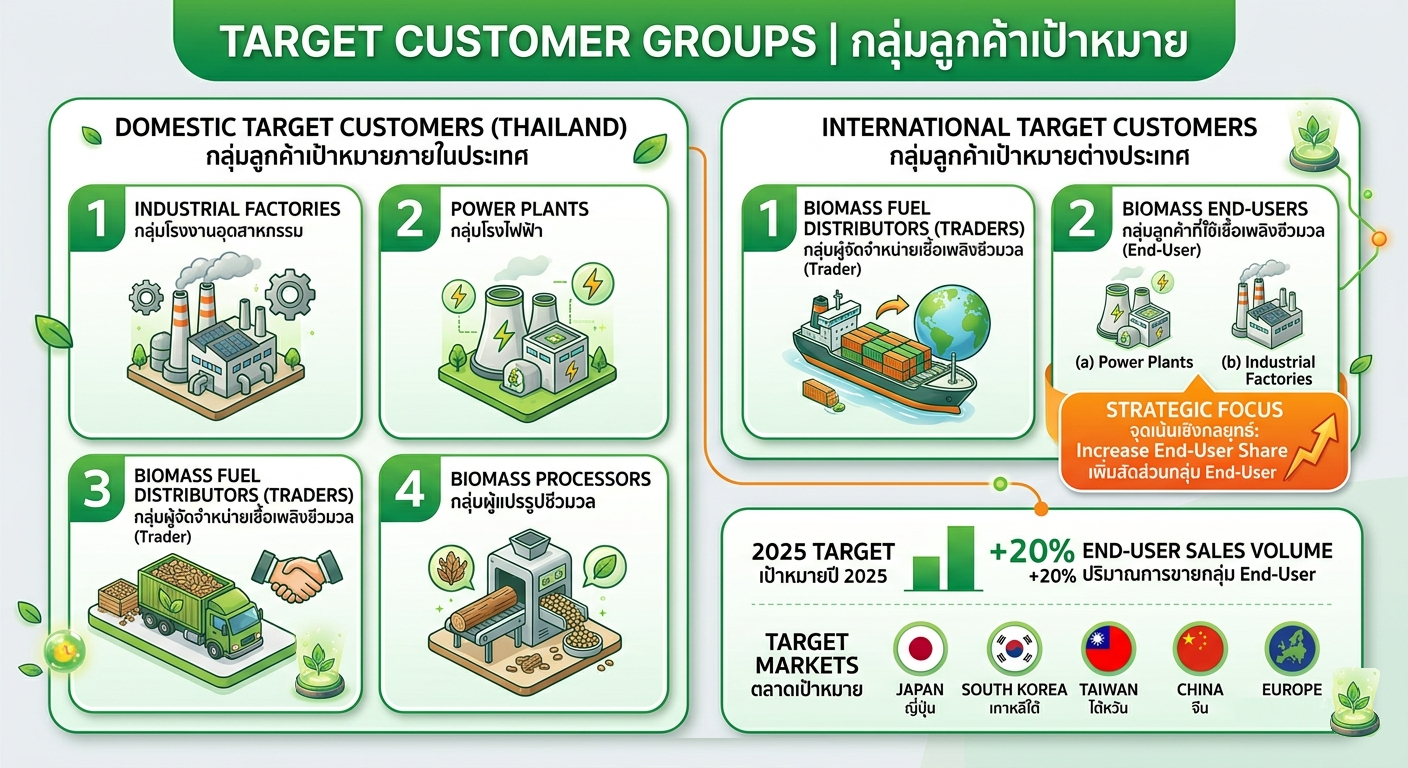
At this time, the Company and its subsidiaries distribute biomass fuel to domestic and international customers. The proportion of distribution to domestic and international customers divide as follows:
Domestic Customers
Domestic customers who want to use biomass fuel in the production and distribution are divide into 4 groups as follows:
Industrial factor
Power plant
Biomass fuel distributor group (“Trader”)
Biomass processor group
Industrial customers are considered to have the highest proportion of biomass fuel purchases by the company, as they continue to use biomass fuel in their production processes. Regularly, while the product is still in production, these customers have a demand for biomass fuel. Industrial customers who use biomass fuel in the production process include:
Industrial plants located near pollution control areas or communities.
Customers who sell products to customers who require manufacturers to produce low-carbon products or protect the environment.
Customers with environmental awareness
In addition to industrial customers, power plant customers are also considered customers who use biomass fuels in their production processes.
Oversea Customers
Overseas Target Customers as follows:
Biomass Fuel Distributor Group (“Trader”)
Customers who use biomass fuel (End-User), which are power houses and industrial plants, etc.
The company is striving to develop relationships with end-users of biomass fuel to increase their proportion. By 2025, end-users are projected to account for a 20% increase in sales volume. These end-users include power plants and industrial factories that utilize biomass fuel in their production processes. The company and its subsidiaries assure international customers of their reliability by maintaining warehouses capable of storing high-quality and sufficient quantities of goods. Customers can inspect the products before delivery, ensuring timely compliance with customer specifications. The company's target markets include Japan, South Korea, Taiwan, China, and European countries. Looking ahead, the proportion of international customers is expected to expand further due to government policies supporting renewable energy at both global and national levels, enabling the company and its subsidiaries to expand their overseas customer base.
Industry & Competition (Overall)
The Competition
The biomass fuel supply and distribution market is a market composed of many entrepreneurs who can engage in the supply and distribution of biomass fuels, including:
Main traders
Small traders
Manufacturer
The company is one of the leaders in the main biomass fuel supply and distribution business. The factors that make the company more competitive than other companies come from:
The experience of the major shareholders in the biomass fuel business for more than 60 years has made the company understand the biomass fuel market in terms of both customer needs and product sources. By having good relationships with both buyers and sellers, the company is able to source and recommend biomass fuels that are suitable for customer needs.
Provide various types of high-quality biomass fuels to meet the needs of all customer groups.
Certification of wood by-product products under the sustainable forest management standard FSC Chain of Custody (CoC) of The Forest Stewardship Council (“FSC”) enables the Company to expand its market to users who require this certification, such as Japan and South Korea, who will only purchase products certified by FSC standards. Therefore, it is an important point for the Company to expand its distribution to more international markets in the future. In order to obtain FSC (CoC), certified products must be able to trace the entire production chain, from the source of the wood, production, transportation to storage that complies with the specified standards.
Supplying biomass fuel in the quantity and at the time customers need it. The company and its subsidiaries assess the demand for biomass fuel by asking customers directly in order to plan the supply in line with the quantity customers need. They also have warehouses to store a large quantity of products to support customer demand throughout the season. They also have efficient transportation management, both from STP and other transportation companies, which enables the products to be delivered on time.
Effective cost management. The company and its subsidiaries can manage product costs as many warehouses are located near domestic and international production bases. The company and its subsidiaries can collect biomass fuel during high production periods, thereby reducing prices and selling it when customers need it. In addition, our company and its subsidiaries emphasize effective transportation management, attempting to manage goods directly from suppliers to customers without going through our warehouse ("direct transportation"), and setting transportation prices for STP and other transportation service providers at reasonable cost levels.
The Company and its subsidiaries have a solid and strong capital base, so they have sufficient working capital to purchase and invest in inventory to support the expansion of demand in the biomass fuel market.
Industry Outlook
Demand and Supply of Renewable Energy in Various Countries and Regions, 2025-2026.
Thailand's Biomass Fuel Market
The overall domestic market in 2025 is projected to continue expanding, primarily driven by the industrial sector's desire to reduce carbon emissions (decarbonization) and comply with environmental measures.
Demand: The demand for biomass fuels (e.g., wood chips, biomass pellets, palm kernel shells) is growing well among large-scale industrial plants (for heat/steam production) and biomass power plants that sell electricity to the government grid under contract.
Supply: Domestic raw materials are becoming increasingly tight during certain seasons (e.g., the rainy season affecting wood chip processing and transportation), as well as price competition between domestic use and exports.
Policy Support: The Thai government is pushing forward a new Power Development Plan (PDP) focusing on increasing the proportion of renewable energy to 51% by 2037, ensuring continued long-term demand for biomass.
The international biomass fuel market
The global market is expanding in line with sustainability (ESG) trends, with the Asia-Pacific region leading the way as the largest market.
The Chinese biomass fuel market
Status: A major global consumer and producer
Market conditions: China is implementing stringent energy transition policies to achieve carbon neutrality goals, resulting in very high biomass demand for both power plants and co-firing with coal. However, China also has a very high domestic supply capacity, but still needs to import some from neighboring ASEAN countries.
Japanese and South Korean Biomass Fuel Markets (Asian Demand Hubs)
Market Conditions: Japan is one of the world's largest importers of wood pellets and palm kernel shells (PKS) due to the launch of biomass power plants under the Feed-in Tariff (FIT) policy.
Key Focus: The Japanese and South Korean markets prioritize not just quantity but also "traceable sustainability certifications" (e.g., GGL, FSC, or SBP). Certified products command premium prices and long-term purchase contracts.
Last year, Japan imported record amounts of biomass pellets due to the opening of new biomass power plants under the government's FIT policy. Japan is a market that emphasizes quality and sustainability certifications (e.g., FSC, GGL). Japan's main supply comes from Vietnam (accounting for over half), followed by Malaysia, Indonesia, and Thailand.
EU Biomass Fuel Market
Market Conditions: Europe is the world's largest consumer of biomass, used for both industrial and household heating applications.
New Regulations to Watch: The implementation of RED III and EUDR (Deforestation-Free Goods) regulations requires that biomass exports to Europe clearly specify the geolocation of the plantation, creating a distinct separation between the general biomass market and the high-standard biomass market.
Domestic/Export Sales Ratio (Overall)
| Country | Ratio (%) |
|---|---|
| Laos | 16.5 |
| Myanmar | 0.17 |
| Taiwan | 37.01 |
Procurement of Products & Services
Reporting Mode
3116
Per-Business-Group Breakdown
| Procurement | Raw Material Acquisition | Production Policy | Distributors | No. of Distributors | Production Capacity | Purchase Proportion |
|---|---|---|---|---|---|---|
The Company and subsidiaries’ biomass fuel procurement are divided into 2 types:
The Company and its subsidiaries' biomass fuel procurement focuses on procuring biomass fuel directly from producers. However, procuring biomass fuel from traders is another important channel. For domestic biomass fuel procurement, although the Company and its subsidiaries have the ability to directly access manufacturers and mainly procure biomass fuel from manufacturers, especially palm kernel shells, whose product quantities depend on the season and manufacturers hedge their own risks by not selling all products to a single buyer, the Company’s addition of a procurement channel with traders has helped make the Company’s biomass fuel procurement more efficient. For example, in cases where biomass fuel is in large quantities and the price is not high, traders can help procure biomass fuel for the Company and its subsidiaries. During periods when biomass fuel is decreasing and the price is high, the Company and its subsidiaries can procure those biomass fuels from traders at reasonable prices,enabling the Company and its subsidiaries to procure biomass fuels in quantities and at prices that customers want without having to keep the biomass fuels on their own. This is considered another way of managing the Company and its subsidiaries’ costs and inventory. In terms of procurement of biomass fuels abroad, in the past, the Company had to rely mainly on the procurement channel from traders because the Company was in the process of developing relationships with overseas manufacturers in both Indonesia and Malaysia. | Palm Kernel Shell Procurement The Company and subsidiaries have procured palm kernel shells from domestic and international suppliers according to the procurement plans from assessing customers’ needs in advance. For heat energy production, palm kernel shells are considered as a crucial biomass fuel due to providing high calorific value. The quantity of palm shells depends on palm oil production in Thailand. However, the quantity of palm kernel shells in Thailand was insufficient for the demand, so the palm kernel shells were imported from Indonesia and Malaysia. which are the world's number 1 and 2 producers of oil palm respectively. The theoretical quantity of palm kernel shells using biomass to oil palm production ratio is 0.04. Therefore, the quantity of palm kernel shells imported from these 2 countries cannot be determined. For other wood waste biomass, the Energy for Environment Foundation assessed the potential of lumber waste biomass. Only 13 types of wood are permitted into sawmills according to the announcement of the Ministry of Industry and Forestry Department are Eucalyptus, Tan Wattle, Brown Salwood, Lead tree, Shorea, Australian Pine, Mountain Ru, Coconut, Tamarind, Marian Plum, Burmese Grape, Raintree, and Palmyra Palm. Domestic sourcing of palm kernel shell The sourcing of palm kernel shells in the country is only to meet the needs of domestic customers. Most of the Company's palm kernel shells domestic purchases will do through PPP since palm kernel shells classify as VAT exempted biomass fuels. Currently, PPP's domestic supply of palm kernel shells is 66% to 98% approximately of the total palm shell supply which can divide into 2 types of procurement which are:
Overseas Palm Kernel Shell Procurement The Company and subsidiaries also procure palm shells from abroad to increase the ability to meet customers' needs in quantity, quality, and prices. The Company has purchased palm kernel shell from Malaysia and Indonesia which are 1st and 2nd largest oil palm plantation countries in the world, to be used as a source of supply and collecting palm kernel shells from manufacturers in those countries for the Company solely and purchase from overseas to sell to customers. The Company can be divided biomass fuel procurement into 2 types as follows:
Currently, sourcing through traders is the most popular type of sourcing for overseas palm kernel shells. In 2022 to 2025, it will account for approximately 20% to 50% of the total sourcing. In the future, the Company and its subsidiaries plan to increase direct sourcing to the highest proportion when the Company and its subsidiaries can develop relationships with crude palm oil mills. The sourcing of overseas palm kernel shells will be done by contracts specifying the quantity and purchase price in a short period of time. Payment to overseas suppliers will be made as agreed in the contract by letter of credit (L/C) or by bank transfer. The procurement of palm shells in Indonesia and Malaysia is to meet the needs of Thai and foreign customers. Currently, Thailand's import and sales ratio is higher than that of overseas customers. However, due to the increase in the number of biomass power plants, the proportion of purchases exported to overseas customers is expected to increase in the future. The company and its subsidiaries have obtained licenses from the Ministry of Agriculture to import palm shells from Indonesia and Malaysia. Sourcing palm kernel shells from various sources helps the Company and its subsidiaries to manage price fluctuations more effectively. This is because the price of palm kernel shells from each source depends on the harvest season, supply and demand in each market, which are different at each time. The Company and its subsidiaries can manage by purchasing from sources with cheaper selling prices. In addition, palm kernel shells from each crude palm oil extraction plant and each country have different qualities and characteristics, which can be assessed from the size, moisture content, and impurities of the palm kernel shells. The quality of the palm kernel shells depends on the production process of the crude palm oil extraction plant, the storage of the palm kernel shells from each source, and the thickness of the palm kernel shells. The Company and its subsidiaries will grade the palm kernel shells they have purchased so that they can be delivered to meet customer needs. | The Company operates as a distributor and not as a manufacturer that procures raw materials for use in the production of goods for sale. | The Company’s seven key suppliers consisted of two overseas suppliers and five domestic suppliers. The two overseas suppliers, ranked first and fourth, were based in Indonesia, with a combined import volume of approximately 26,000 tons. Both have maintained long-standing business relationships with the Company. The five domestic suppliers were also long-standing trade partners of the Company. Each supplied more than 5,000 tons, with a combined volume of approximately 37,000 tons. Altogether, these seven key suppliers accounted for approximately 43% of the Company’s total purchase volume. | 80 | Palm kernel shells · Unit: Ton · Spent: 0.0 · Total: 0.0 · Unit code: 2950 | 262332076.16 · Country code: 3357 · Country name: Other · Raw material name: Domestic sourcing of palm kernel shell · 82279905.02 · Country code: 3357 · Country name: Other · Raw material name: Overseas Palm Kernel Shell Procurement |
Woodchip and other parts of Wood Procurement The Company directly procures woodchip from the chopped wood yard, and other parts from a wooden furniture factory, lumber factories, and sawmills in the country in the south, central, eastern, northeastern, and northern regions, with each area of the country having different quantities of each type of product. The biomass procurement department will procure them directly from each producer because it is a product with continuous supply, and the Company can choose to buy from the production source that is closest to the user for the most efficient transportation cost. As for the trading of woodchips, the Company has contracts and orders through purchase orders with suppliers. Most of the agreements made are 1-year contracts and set purchase prices in advance. The Company will order slabs through a purchase order with the supplier on a one-time basis. Most of the payment for this group of products will be credited to the supplier. | Woodchip and other parts of Wood Procurement The Company directly procures woodchip from the chopped wood yard, and other parts from a wooden furniture factory, lumber factories, and sawmills in the country in the south, central, eastern, northeastern, and northern regions, with each area of the country having different quantities of each type of product. The biomass procurement department will procure them directly from each producer because it is a product with continuous supply, and the Company can choose to buy from the production source that is closest to the user for the most efficient transportation cost. As for the trading of woodchips, the Company has contracts and orders through purchase orders with suppliers. Most of the agreements made are 1-year contracts and set purchase prices in advance. The Company will order slabs through a purchase order with the supplier on a one-time basis. Most of the payment for this group of products will be credited to the supplier. | The Company sources woodchips and other wood residues entirely from domestic suppliers. The top five suppliers accounted for a combined volume of approximately 30,000 tons, representing around 36% of the Company’s total sourcing volume. | The Company sources woodchips and other wood residues entirely from domestic suppliers. The top five suppliers accounted for a combined volume of approximately 30,000 tons, representing around 36% of the Company’s total sourcing volume. | 162 | No · Unit: Ton · Spent: 0.0 · Total: 0.0 · Unit code: 2950 | 615513864.73 · Country code: 211 · Country name: Thailand · Raw material name: Woodchip and Others |
Wood Pellets Procurement The Company directly supplies biomass briquettes to local biomass briquette manufacturers. Most of them are located in the eastern and southern regions and are studying procurement guidelines process from foreign suppliers. The biomass briquette producers in Thailand can divide into 3 sizes according to their production capacity, namely (1) A large producer with a capacity of 5,000 tons per month or more (2) A middle-man with a capacity of 1,000 to 5,000 tons per month (3) Small scale, production capacity is less than 1,000 tons by production size, and the ability to continuously supply products is crucial in choosing to be a supplier of biomass briquettes for the Company. The Company will have a purchase agreement with the Supplier, payment terms will be under the contract. There are both credit purchases and advance payments. | Wood Pellets Procurement The Company directly supplies biomass briquettes to local biomass briquette manufacturers. Most of them are located in the eastern and southern regions and are studying procurement guidelines process from foreign suppliers. The biomass briquette producers in Thailand can divide into 3 sizes according to their production capacity, namely (1) A large producer with a capacity of 5,000 tons per month or more (2) A middle-man with a capacity of 1,000 to 5,000 tons per month (3) Small scale, production capacity is less than 1,000 tons by production size, and the ability to continuously supply products is crucial in choosing to be a supplier of biomass briquettes for the Company. The Company will have a purchase agreement with the Supplier, payment terms will be under the contract. There are both credit purchases and advance payments. | The Company operates as a distributor and not as a manufacturer that procures raw materials for use in the production of goods for sale. | The Company sources Wood Pellets entirely from domestic suppliers. The top five suppliers accounted for a combined volume of approximately 23,500 tons, representing around 69% of the Company’s total sourcing volume. | 33 | No · Unit: Ton · Spent: 0.0 · Total: 0.0 · Unit code: 2950 | 114067955.13 · Country code: 3357 · Country name: Other · Raw material name: Domestic sourcing of Wood Pellets |
The Company sources eucalyptus woodchips for distribution from domestic suppliers. Suppliers are selected based on product quality and their ability to ensure a consistent and reliable supply in order to meet customer demand. The Company operates as a distributor and not as a manufacturer that procures raw materials for the production of goods for sale. | Details of the procurement of raw materials used in production or services, categorized under Business Group 2. | The Company operates as a distributor and not as a manufacturer that procures raw materials for use in the production of goods for sale. | The Company sources eucalyptus woodchips entirely from domestic suppliers. The top five suppliers accounted for a combined volume of approximately 68,000 tons, representing around 53% of the Company’s total sourcing volume. | 32 | No · Unit: Ton · Spent: 0.0 · Total: 0.0 · Unit code: 2950 | 33434974.06 · Country code: 211 · Country name: Thailand · Raw material name: Wood chip Eucalyptus |
Wood Shavings, Sawdust, Wood Dust Procurement The Company directly procures sawdust, shavings, and wood dust from wood furniture factories, sawmills, and lumber factories in the country in the southern, central, eastern, northeastern and northern regions as no price volatility products. Therefore, contracts with suppliers are contracted for 1 to 3 years and set purchase prices in advance with all suppliers. Some suppliers have contracted to sell products to the Company solely (Exclusive contracts) by buying from each supplier will vary, according to the quality of the product and delivery, which the payment terms will be by the contract. There are both cash purchases, credit purchases, and advance payments. Most of the suppliers of sawdust, shavings, and wood dust of the Company are suppliers that have been in contact for a long time. Most of them are located in the central and the eastern region. | Wood Shavings, Sawdust, Wood Dust Procurement The Company directly procures sawdust, shavings, and wood dust from wood furniture factories, sawmills, and lumber factories in the country in the southern, central, eastern, northeastern and northern regions as no price volatility products. Therefore, contracts with suppliers are contracted for 1 to 3 years and set purchase prices in advance with all suppliers. Some suppliers have contracted to sell products to the Company solely (Exclusive contracts) by buying from each supplier will vary, according to the quality of the product and delivery, which the payment terms will be by the contract. There are both cash purchases, credit purchases, and advance payments. Most of the suppliers of sawdust, shavings, and wood dust of the Company are suppliers that have been in contact for a long time. Most of them are located in the central and the eastern region. | The Company operates as a distributor and not as a manufacturer that procures raw materials for use in the production of goods for sale. | The Company sources Wood Shaving/ Sawdust entirely from domestic suppliers. The top five suppliers accounted for a combined volume of approximately 37,000 tons, representing around 70% of the Company’s total sourcing volume. | 92 | No · Unit: Ton · Spent: 0.0 · Total: 0.0 · Unit code: 2950 | 54315368.25 · Country code: 211 · Country name: Thailand · Raw material name: Wood Shaving/ Sawdust |
The company procures RDF from industrial or commercial sources, which is municipal solid waste that has undergone physical processes such as sorting, sifting, reducing size, reducing moisture, etc., to obtain combustible materials of appropriate size and properties | The company procures RDF from industrial or commercial sources, which is municipal solid waste that has undergone physical processes such as sorting, sifting, reducing size, reducing moisture, etc., to obtain combustible materials of appropriate size and properties | The Company operates as a distributor and not as a manufacturer that procures raw materials for use in the production of goods for sale. | The Company sources RDF entirely from domestic suppliers. The top five suppliers accounted for a combined volume of approximately 67,700 tons, representing around 53% of the Company’s total sourcing volume. | 33 | No · Unit: Ton · Spent: 0.0 · Total: 0.0 · Unit code: 2950 | 33434974.06 · Country code: 3357 · Country name: Other · Raw material name: Domestic sourcing of RDF |
Projects Under Construction
Has Projects Under Construction (Y/N)
No
Debentures & Bills of Exchange
Has Debentures (Y/N)
No
Convertible Securities
Has Convertible Securities (Y/N)
No