

Sustainability · 2025
In this section50 topics
- Sustainability Policy4 items
- Sustainability Goals & UN SDGs3 items
- Policy Review2 items
- Business Value Chain1 item
- Stakeholder Analysis1 item
- Environmental Policy & Guidelines5 items
- Environmental Policy Review3 items
- Energy — Plan & Guidelines2 items
- Energy — Electricity Consumption1 item
- Energy — Fuel Consumption1 item
- Energy — Targets2 items
- Energy — Performance & Outcomes2 items
- Water — Plan & Guidelines2 items
- Water — Withdrawal, Discharge & Consumption1 item
- Water — Targets2 items
- Water — Performance & Outcomes2 items
- Waste — Plan & Guidelines2 items
- Waste — Generation, Disposal & Recycling1 item
- Waste — Targets2 items
- Waste — Performance & Outcomes2 items
- GHG — Plan & Guidelines2 items
- GHG — Emissions1 item
- GHG — Emissions Verification4 items
- GHG — Principles & Standards1 item
- GHG — Targets1 item
- GHG Targets — Other Targets1 item
- GHG — Performance & Outcomes2 items
- Environmental Legal Incidents1 item
- Other Environmental Management1 item
- Social Policy & Guidelines5 items
- Social Policy Review3 items
- Social — Principles & Standards Practised1 item
- Human Rights Due Diligence2 items
- Employees — Plan & Guidelines3 items
- Employees — Workforce1 item
- Employees — Remuneration & Provident Fund1 item
- Employees — Training & Development1 item
- Employees — Occupational Health & Safety1 item
- Employees — Labour Relations1 item
- Employees — Employee Representation2 items
- Employees — Targets2 items
- Employees — Performance & Outcomes2 items
- Customers — Plan & Guidelines3 items
- Customers — Satisfaction Results1 item
- Customers — Targets2 items
- Customers — Performance & Outcomes2 items
- Community & Social — Plan & Guidelines3 items
- Community & Social — Targets2 items
- Community & Social — Performance & Outcomes2 items
- Law Violation Incidents1 item
Sustainability Policy
Has a Sustainability Policy
Yes
Policy Description
Asia Biomass Public Company Limited and its subsidiaries are committed to conducting business responsibly, considering all stakeholders, and operating ethically. We respect human rights, are free from corruption, and manage enterprise risks by identifying sustainability risks through stakeholder analysis. This is then used to define operational goals, policies, projects, and activities that meet the expectations of each stakeholder group. We manage our supply chain and develop strategic plans for sustainable development.
The company aims to be a flagship for sustainable energy, creating shared value for all stakeholders through a balanced approach to economic performance, social responsibility, and environmental conservation, all under the principles of excellent governance. To ensure clarity in sustainability management, we have established a comprehensive "Sustainability Management Policy" encompassing three dimensions: economic, social, and environmental, to guide our business operations towards sustainable growth.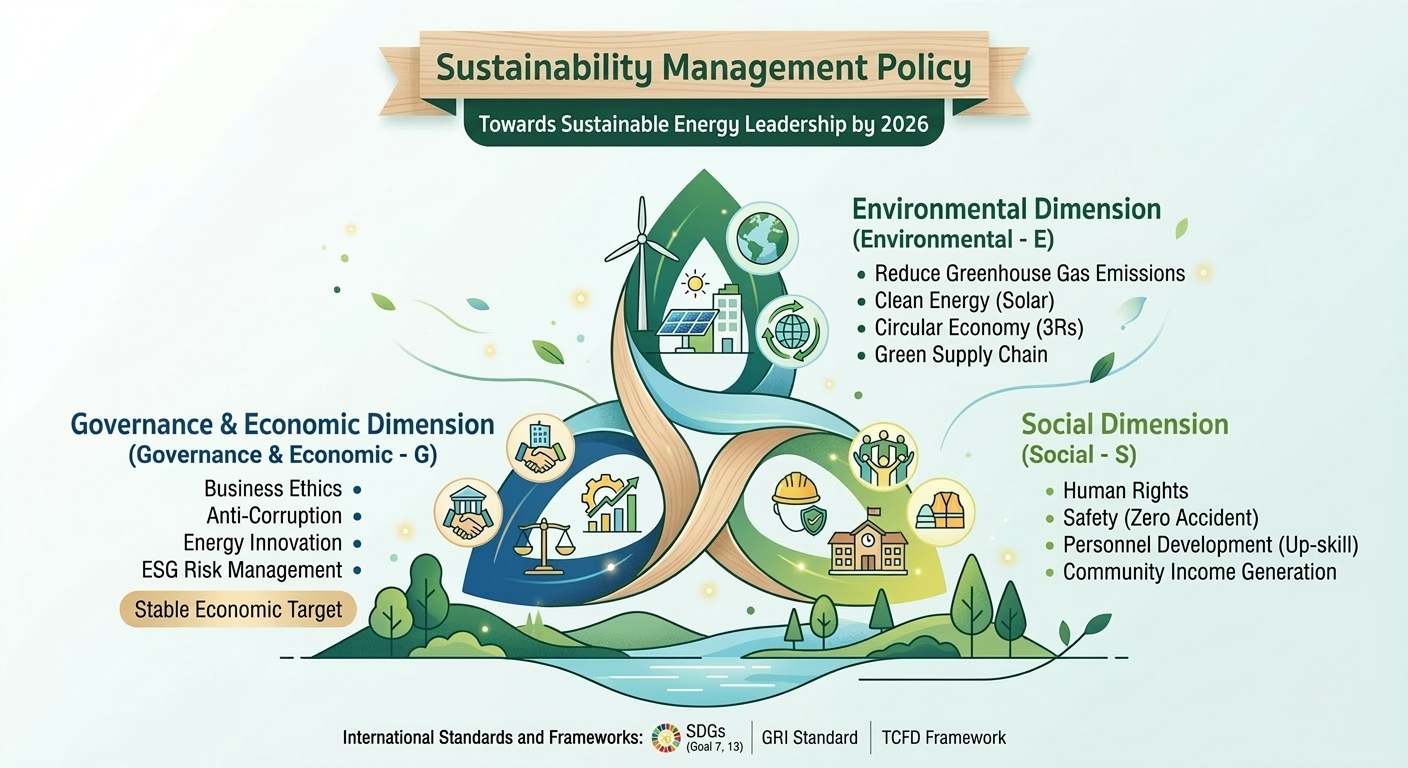
Policy Document Link
https://www.asiabiomass.com/en/download/sustainability-management-policy/?wpdmdl=11085&refresh=69ba1558ab40a1773802840
Page Number in Report
1-4
Sustainability Goals & UN SDGs
Has Sustainability Goals
Yes
Goals Description
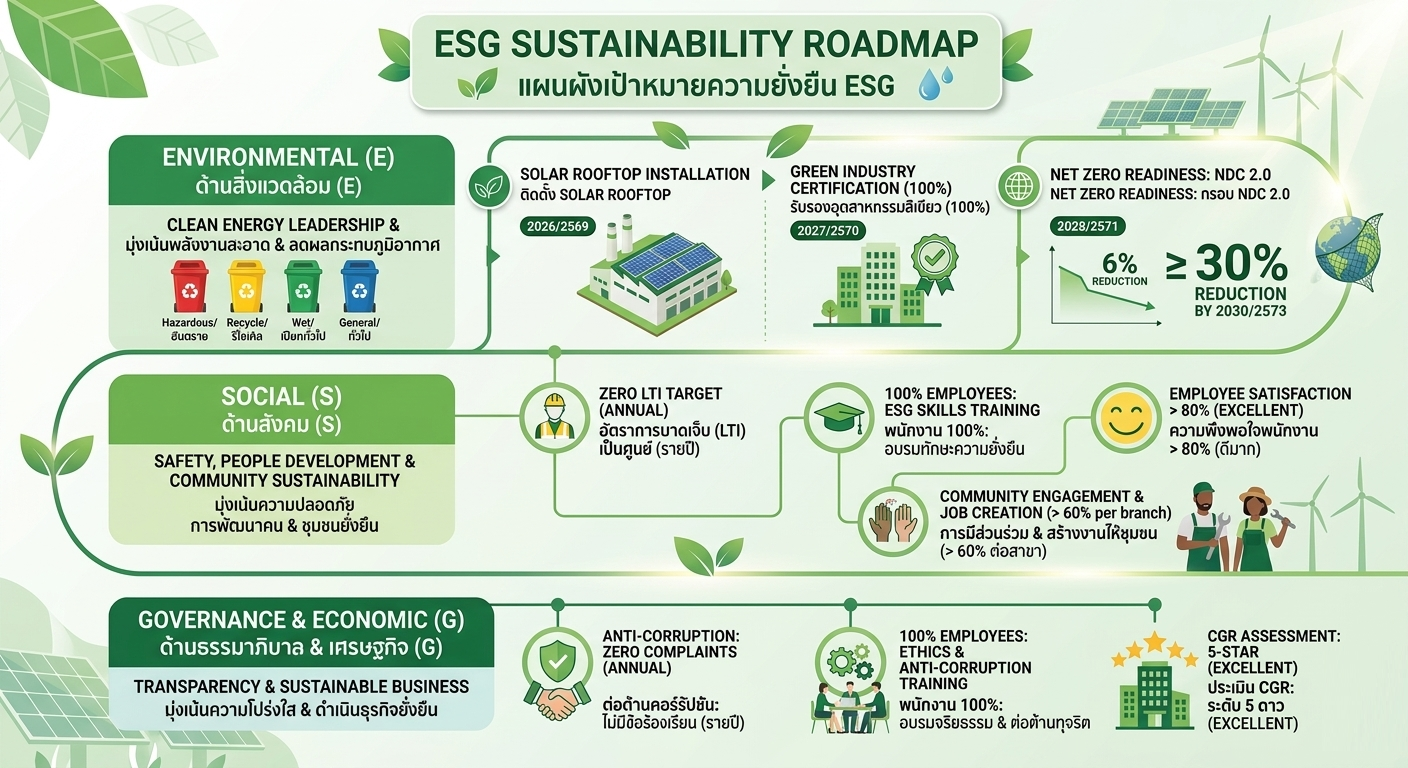
Asia Biomass Public Company Limited is committed to being a flagship for sustainable energy. The company views sustainability not merely as a responsibility, but as a core element in building a competitive advantage. Therefore, the company integrates ESG principles into its business strategy, aligning with its vision to create a stable balance between economic performance, social responsibility, and environmental conservation. The company has set goals based on the following ESG dimensions :
Environmental Targets
Focus on leadership in clean energy and climate impact reduction :
Waste Reduction : Waste sorting at all company warehouses, categorized into four types :
1.1 Hazardous waste (red bin),
1.2 Recyclable waste (yellow bin),
1.3 General wet waste (green bin),
1.4 General waste (blue bin).
Increasing the use of clean energy within the organization through the installation of solar rooftops covering all warehouse areas by 2026.
All company warehouses must be 100% Green Industry certified by 2027.
Net Zero Readiness: Reduce greenhouse gas emissions by 6% by 2028 and aim for a reduction of at least 30% by 2028, in line with NDC 2.0
Social Targets
Focus on safety, human resource development, and community sustainability :
Occupational Health & Safety : Maintaining workplace safety with the goal of achieving zero lost-time injuries (LTI) annually.
100% of employees must receive sustainability skills training.
Maintaining a "very good" employee satisfaction score (above 80%) to reduce turnover and create a happy workplace.
Engaging and creating jobs for more than 60% of each company branch's community.
Governance & Economic Targets
Focusing on transparency and sustainable business practices
Anti-Corruption : Maintaining anti-corruption standards by having no complaints of fraud or unethical business practices throughout the year.
100% of employees must receive training in ethics and anti-corruption policies.
Transparency & Disclosure: Elevating the CGR (Corporate Governance Rating) score to "5 stars" (Excellent).
UN Sustainable Development Goals
| SDG Goal |
|---|
| Goal 4 Quality Education |
| Goal 7 Affordable and Clean Energy |
| Goal 8 Decent Work and Economic Growth |
| Goal 9 Industry, Innovation and Infrastructure |
| Goal 11 Sustainable Cities and Communities |
| Goal 12 Responsible Consumption and Production |
| Goal 13 Climate Action |
| Goal 16 Peace, Justice and Strong Institutions |
Policy Review
Policy Reviewed This Year
Yes
Policy Changed This Year
No
Business Value Chain
Value Chain Description
Business Value Chain of Asia Biomass Public Company Limited
Asia Biomass Public Company Limited, or ABM, has operated alongside Thailand's growth for over 60 years, demonstrating its commitment to achieving balanced growth between economic performance and environmental and social responsibility. The company operates on the basis of 'Green Value Chain' which transforms agricultural produce and industrial waste materials into high-value clean energy, under internationally recognized standards, to deliver energy security and create maximum benefits for all stakeholders sustainably, covering from upstream to downstream.
-
Responsible Raw Material Sourcing (Green Sourcing - E & S)
The company focuses on raw material management based on Circular Economy principles by collecting waste materials from the agricultural and industrial sectors (sawdust, palm kernel shells, wood shavings) and processing them according to the 3R's principles to reduce reliance on fossil fuels. Furthermore, we support the grassroots economy through direct procurement from farmers and local logging team networks, with traceability of origin according to FSC-CoC standards to ensure that all procurement processes do not involve forest destruction.
-
Eco-friendly Production and Innovation (E & G) With four strategic production and processing bases nationwide, ABM elevates production standards with ISO 9001:2015 and ISO 14001:2015 systems to ensure consistent product quality and environmentally friendly processes. We collaborate with outsourcing partners to transfer technology and expand competitive capabilities simultaneously across the entire supply chain.
-
Sustainable Logistics (G & S) The company enhances delivery efficiency through three main warehouses (Bang Nam Chuet, Bang Kung, Rayong), strategically located for logistics, to reduce energy consumption in transportation and maintain supply security to accurately and quickly meet the demands of both domestic and international customers.
Stakeholder Analysis
Stakeholder Analysis
| Stakeholder Type | Stakeholders | Stakeholder Expectations | Response to Expectations | Communication Activities |
|---|---|---|---|---|
| Internal stakeholders | 2921 · Description: Employees | • Safe working environment
• Skills development and career advancement
• Appropriate compensation and benefits
• Human rights
• Employee engagement activities | • Safety management with standard systems
• Target zero Lost Time Injury (LTI) rate
• Conduct internal and external training
• 100% employee training on sustainability and ethics
• Fair and verifiable compensation and performance appraisal system
• Provident fund
• Adherence to human rights policy
• Employee engagement activities | 2941 · Description: Online Communication · 2942 · Description: Internal Meeting · 2945 · Description: Complaint Reception · 2946 · Description: Employee Engagement Survey · 2947 · Description: Satisfaction Survey · 2948 · Description: Training / Seminar · 2949 · Other name: Welfare Committee Meeting, once per quarter · Description: Others · 2949 · Other name: Annual Employee Happiness and Engagement Survey · Description: Others |
| External stakeholders | 2904 · Description: Investors or investment institutions · 2913 · Description: Shareholders | Good and sustainable financial performance
• Good corporate governance
• Effective risk management
• Accurate and complete information disclosure
• Transparency and auditability | • Targeting revenue of 2,000 - 2,500 million Baht (2026)
• Good and fair corporate governance
• Developing short-term and medium-term strategic plans for the company
• Disclosing information fully and transparently
• Risk management to mitigate organizational risks | 2938 · Description: Visit · 2939 · Description: Press Release · 2941 · Description: Online Communication · 2944 · Description: Annual General Meeting (AGM) · 2945 · Description: Complaint Reception |
| External stakeholders | 2923 · Description: Customers | • Quality products
• Timely and accurate delivery
• Excellent after-sales service
• Reasonable pricing
• Complete and accurate product information
• Confidentiality of information | • Product quality control and on-time delivery
• Quality control with ISO 9001 and FSC-CoC
• After-sales service and regular client visits
• Tracking and handling product claims
• Selling products at market prices
• Warehouse and logistics management at strategic locations | 2938 · Description: Visit · 2941 · Description: Online Communication · 2945 · Description: Complaint Reception · 2947 · Description: Satisfaction Survey · 2949 · Other name: Regular customer visits · Description: Others |
| External stakeholders | 2893 · Description: Farmers · 2899 · Description: Suppliers | • Procurement of raw materials at fair prices
• Fair purchase and sale agreements
• Continuity in procurement
• Transparent and fair business operations | • Drafting contracts mutually agreed upon by both parties
• Fair negotiation between both parties
• Continuous purchase and sale agreements | 2938 · Description: Visit · 2941 · Description: Online Communication · 2949 · Other name: Meeting and Discussion · Description: Others |
| External stakeholders | 2902 · Description: Community · 2928 · Description: Society | • Job creation and income generation in local communities
• Operations with no environmental impact
• Support for community activities and participation in community and social development | • Employing local residents in each branch
• All warehouses have achieved 100% green industry certification
• Implementation of measures to prevent community impact
• Implementation of fire prevention measures
• Systematic waste segregation and management in all warehouses | 2938 · Description: Visit · 2940 · Description: Social Event · 2941 · Description: Online Communication · 2943 · Description: External Meeting · 2945 · Description: Complaint Reception · 2949 · Other name: There is a community relations unit. · Description: Others · 2949 · Other name: Community Engagement Activities · Description: Others · 2949 · Other name: Community Dialogue Activities · Description: Others · 2949 · Other name: Periodic field visits to assess community impacts. · Description: Others |
| External stakeholders | 2931 · Description: Government agencies and Regulators | • Compliance with laws, regulations, and rules in all aspects related to business operations
• Transparency in information disclosure
• Participation in and support for various government projects | • Strictly adhere to business-related rules and regulations
• Disclose information transparently
• Report information as required by law
• Annual report | 2939 · Description: Press Release · 2941 · Description: Online Communication · 2948 · Description: Training / Seminar |
| External stakeholders | 2898 · Description: Competitors | • Confidentiality
• Fair treatment of competitors | • Do not seek confidential information of competitors.
• Do not damage the reputation of competitors. | 2949 · Other name: Meetings and Discussions, Information, Members, Marketing Activities · Description: Others |
| Internal stakeholders | 2897 · Description: Board of director | • Governance and Transparency
• Business Sustainability, Maintaining Profitability, Coupled with Green Energy Growth
• Risk Management, Risk Control
• Regulatory Compliance, Conducting Business in Accordance with SET Requirements | • Good corporate governance in accordance with policies and strictly enforced
• Business and strategic planning
• Business sustainability, maintaining profitability alongside the growth of green energy
• Risk management and control
• Regulatory compliance, conducting business in accordance with SET requirements | 2942 · Description: Internal Meeting · 2944 · Description: Annual General Meeting (AGM) · 2949 · Other name: Board of Directors Meeting · Description: Others · 2949 · Other name: Sub-committee Meeting · Description: Others |
Environmental Policy & Guidelines
Has an Environmental Policy
Yes
Policy Description
Asia Biomass Public Company Limited is committed to conducting business responsibly towards the environment and society. Recognizing the direct and indirect environmental impacts of its operations, and believing that sustainable economic growth must go hand-in-hand with maintaining ecological balance, the company prioritizes concrete environmental sustainability management. This is achieved through a comprehensive organizational strategy across the entire value chain, aiming to become a leading global clean energy business. Adhering to practices that minimize environmental impact and strive towards a low-carbon society, the company has established environmental policies and practices, setting targets encompassing various management aspects and operating in accordance with these policies and management frameworks to ensure stable and sustainable growth.
Policy Document Link
https://www.asiabiomass.com/en/download/environmental-policies-and-practices/?wpdmdl=11088&refresh=69bb541f5270c1773884447
Page Number in Report
1-4
Environmental Guidelines
| Guideline |
|---|
| Electricity Management |
| Fuel Management |
| Renewable/Clean Energy Management |
| Water Management |
| Waste Management |
| Biodiversity Management |
| Greenhouse Gas and Climate Change Management |
| Air Quality Management |
| Noise Pollution Management |
Environmental Policy Review
Policy Reviewed This Year
Yes
Review Details
Added targets for oil and fuel management:
Goal: Reduce the amount of oil and fuel used in transportation and operations.
Changed targets for greenhouse gas management and climate change:
New target: Net Zero Readiness (reduce greenhouse gas emissions by 6% - 30% by 2028 according to the NDC 2.0 framework).
Policies & Guidelines Changed
| Change |
|---|
| Fuel Management |
| Greenhouse Gas and Climate Change Management |
Energy — Plan & Guidelines
Has an Energy Management Plan
Yes
Plan Description
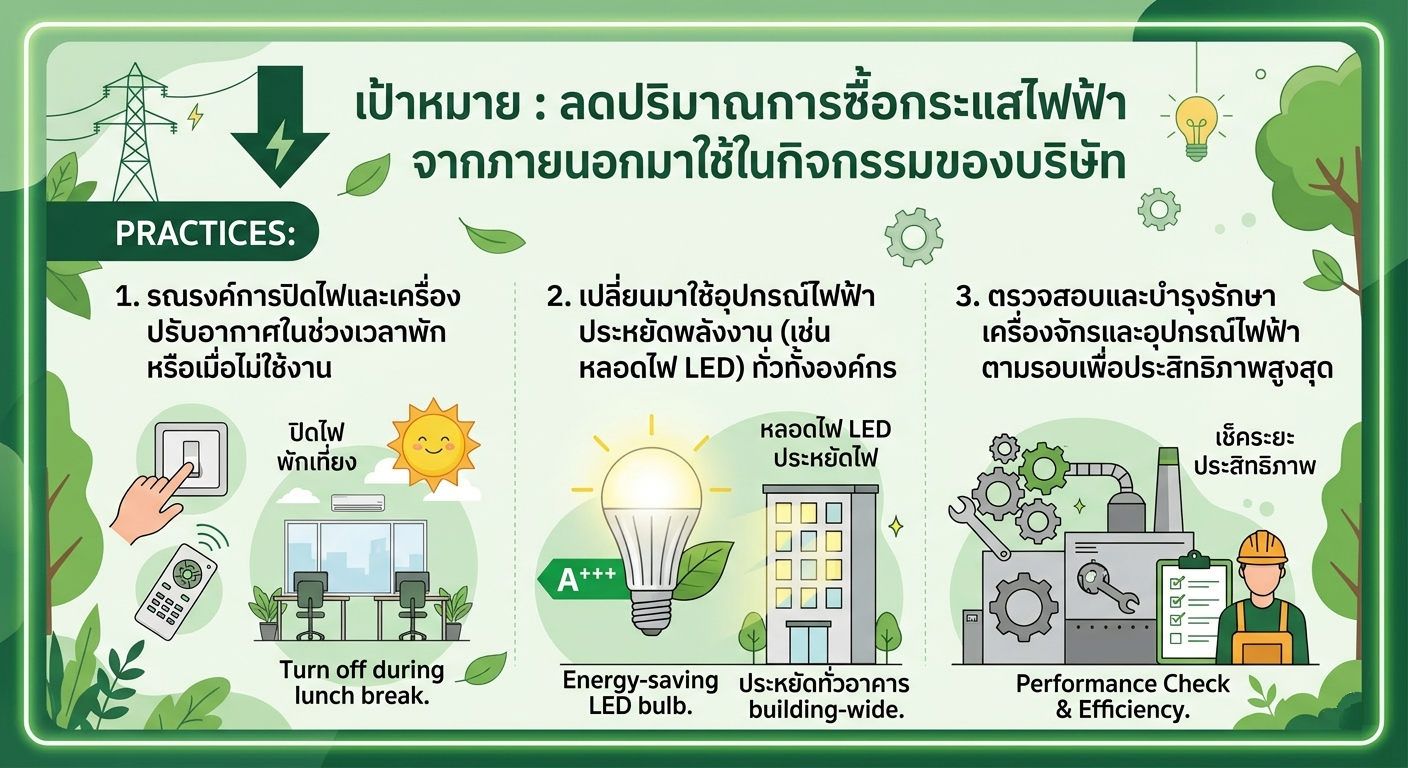
Goal: Reduce the amount of electricity purchased from external sources for company activities.
Practices:
Promote the switching off of lights and air conditioners during breaks or when not in use.
Switch to energyefficient electrical equipment (e.g., LED lights) throughout the organization.
Conduct regular inspections and maintenance of machinery and electrical equipment for optimal efficiency.
Energy — Electricity Consumption
Electricity Consumption
| Metric | Current Year | Previous Year | Two Years Ago |
|---|---|---|---|
| Total electricity consumption within the organization (Kilowatt-Hours) | 3,170,045.3 | 3,006,106 | 3,659,867 |
| Electricity purchased for consumption from non-renewable energy sources (Kilowatt-Hours) | 3,170,045.3 | 3,006,106 | 3,659,867 |
| Electricity purchased or generated for consumption from renewable energy sources (Kilowatt-Hours) |
Energy — Fuel Consumption
Fuel Consumption
| Metric | Current Year | Previous Year | Two Years Ago |
|---|---|---|---|
| Crude oil (Barrels) | |||
| Coal (Metric tonnes) | |||
| Jet fuel (Litres) | |||
| Diesel (Litres) | 106,950.88 | 151,810.54 | 209,508.01 |
| Gasoline (Litres) | 40,698.35 | 47,930.08 | 66,209.82 |
| Fuel oil (Litres) | |||
| Natural gas (Standard cubic feet) | |||
| LPG (Kilograms) | 2,115 | 2,580 | 235.47 |
| Steam (Metric tonnes) |
Energy — Targets
Has Set Targets
Yes
Targets
| Target | Base Year | Base Year Value | Target Year | Target Year Value | Target Change (%) | Unit | Unit — Please Specify | Per Unit (Intensity) | Per Unit — Please Specify |
|---|---|---|---|---|---|---|---|---|---|
| Reduction of electricity purchased for consumption | 2,023 | 15.04 | 2,026 | 12.03 | 20 | Others | Kilowatt | Metric ton of raw material | Metric ton of raw material |
| Reduction of fuel consumption | 2,024 | 0.55 | 2,027 | 0.44 | 20 | Litres | Metric ton of raw material | Metric ton of raw material |
Energy — Performance & Outcomes
Has Performance Results
Yes
Performance Description
The company has designated and selected energy-efficient electrical appliances with the Energy Efficiency Label No. 5, such as refrigerators, air conditioners, LED lighting, and solar-powered spotlights. We also choose high-efficiency IE2 and IE3 motors to help save energy. Furthermore, we have a campaign in place to promote energy conservation across all departments, encouraging the turning off of water, lights, air conditioners, and other electrical appliances when not in use.
The group of companies has implemented efficient energy management measures in several areas, including:
Lighting systems: Energy-efficient LED bulbs are used, solar lighting is utilized, and transparent panels have been added to the side windows of the warehouses to maximize natural light.
Power systems: High-efficiency motors (IE2 and IE3) are selected for energy saving.
Air conditioning systems: Energy-efficient appliances with the Energy Efficiency Label No. 5 are selected and regularly maintained. Energy conservation campaigns are conducted throughout the company, encouraging employees to turn off lights, air conditioners, and other electrical appliances when not in use or when no one is present.
Compressed air systems: High-efficiency screw air compressors are used to save energy in the production process.
The company efficiently manages its energy systems, including lighting and air conditioning, by installing and maintaining related electrical control equipment, resulting in reduced electricity consumption. In addition, the company is in the process of installing a solar rooftop power generation system.
By 2025, the company will use a total of 9.52 kW/ton of raw materials, achieving a 36.7% reduction in electricity costs compared to 2023 (base year), which used 15.04 kW/ton of raw materials and the company uses a total of 0.44 liters of oil and fuel per ton of raw materials, resulting in a 19.28% reduction in oil and fuel consumption compared to 2024 (base year), which used a total of 0.55 liters of oil and fuel per ton of raw materials.
Water — Plan & Guidelines
Has a Water Management Plan
Yes
Plan Description
Goal: Reduce water consumption and maintain water quality in the operational area.
Practices:
Install water-saving devices and regularly check for leaks in the plumbing system.
Promote responsible water usage within offices and warehouses.
Ensure the drainage system is free from contamination before releasing water to the public.
Water — Withdrawal, Discharge & Consumption
Water Withdrawal, Discharge & Consumption
| Metric | Current Year | Previous Year | Two Years Ago |
|---|---|---|---|
| Total water withdrawal (Cubic meters) | 3,746.7 | 4,245.7 | 4,406 |
| Total water withdrawal by third-party water (Cubic meters) | 3,746.7 | 4,245.7 | 4,406 |
| Total water withdrawal by surface water (Cubic meters) | |||
| Total water withdrawal by groundwater (Cubic meters) | |||
| Total water withdrawal by seawater (Cubic meters) | |||
| Total water withdrawal by produced water (Cubic meters) | |||
| Percentage of wastewater treated before discharge (%) | |||
| Total water discharge (Cubic meters) | |||
| Total water discharge to third-party water (Cubic meters) | |||
| Total water discharge to surface water (Cubic meters) | |||
| Total water discharge to groundwater (Cubic meters) | |||
| Total water discharge to seawater (Cubic meters) | |||
| Total water consumption (Cubic meters) | 3,746.7 | 4,245.7 | 4,406 |
| Recycled water (Cubic meters) |
Water — Targets
Has Set Targets
Yes
Targets
| Target | Base Year | Base Year Value | Target Year | Target Year Value | Target Change (%) | Unit | Per Unit (Intensity) | Per Unit — Please Specify |
|---|---|---|---|---|---|---|---|---|
| Reduction of water withdrawal | 2,023 | 40.42 | 2,026 | 36.38 | 10 | Cubic meters | Person(employee) | Person(employee) |
Water — Performance & Outcomes
Has Performance Results
Yes
Performance Description
The group of companies has selected water-efficient equipment, implemented measures and campaigns for water conservation, ensured that water taps are turned off completely after use, and regularly maintained water-related equipment to prevent waste and leakage. Rainwater and treated water are collected and used for environmental activities and watering plants within the warehouse area.
Analysis of water usage data reveals a continuous downward trend in water consumption per employee, reflecting excellent water management efficiency compared to the base year 2023. Key findings are summarized as follows:
2023 : Water consumption of 40.42 cubic meters per person (base year)
2024: Water consumption slightly increased to 42.89 cubic meters per person
2025: Water consumption decreased to 38.51 cubic meters per person, indicating continuous improvement in water management efficiency.
In terms of management efficiency, these results demonstrate the company's ability to control resource utilization in line with its set target: "reducing water consumption by 10% annually from the base year 2023." The reduction in water consumption from 40.42 cubic meters per person in 2022 to 38.51 cubic meters per person in 2025 reflects the tangible success of the water conservation measures implemented.
Waste — Plan & Guidelines
Has a Waste Management Plan
Yes
Plan Description
Goal: Towards Zero Waste to Incineration and Landfill.
Practices based on the 3Rs: Reduce, Reuse, Recycle:
Establish clear sorting points for 4 types of waste in every warehouse:
Hazardous waste (red bin): e.g., batteries, light bulbs, chemical packaging;
Recyclable waste (yellow bin): e.g., paper, plastic, glass, metal;
General wet waste (green bin): food scraps and biodegradable materials;
General waste (blue bin): waste that is not cost-effective to recycle but is not hazardous.
Promote the reuse of leftover materials and forward recyclable waste to the appropriate
Waste — Generation, Disposal & Recycling
Waste Generation, Disposal & Recycling
| Metric | Current Year | Previous Year |
|---|---|---|
| Total waste generated (Kilograms) | 5,494 | 14,681 |
| Non-hazardous waste (Kilograms) | 5,494 | 14,681 |
| Non-hazardous waste - Landfilling (Kilograms) | 5,494 | 14,681 |
| Non-hazardous waste - Incineration (with energy recovery) (Kilograms) | ||
| Non-hazardous waste - Incineration (without energy recovery) (Kilograms) | ||
| Non-hazardous waste - Other disposal operations (Kilograms) | ||
| Hazardous waste (Kilograms) | ||
| Hazardous waste - Landfilling (Kilograms) | ||
| Hazardous waste - Incineration (with energy recovery) (Kilograms) | ||
| Hazardous waste - Incineration (without energy recovery) (Kilograms) | ||
| Hazardous waste - Other disposal operations (Kilograms) | ||
| Total reused/recycled waste (Kilograms) | ||
| Reused/Recycled non-hazardous waste (Kilograms) | ||
| Reused non-hazardous waste (Kilograms) | ||
| Recycled non-hazardous waste (Kilograms) | ||
| Reused/Recycled hazardous waste (Kilograms) | ||
| Reused hazardous waste (Kilograms) | ||
| Recycled hazardous waste (Kilograms) |
Waste — Targets
Has Set Targets
Yes
Targets
| Waste Type | Disposal Approach | Target | Base Year | Base Year Value | Target Year | Target Year Value | Target Change (%) | Unit | Per Unit (Intensity) | Per Unit — Please Specify |
|---|---|---|---|---|---|---|---|---|---|---|
| Non-hazardous waste | 2760 · Description: Landfilling | Increase waste utilization | 2,024 | 14,681 | 2,027 | 10,277 | 30 | Kilograms | Other | Kilograms |
Waste — Performance & Outcomes
Has Performance Results
Yes
Performance Description
The company systematically manages waste and discarded materials in its business operations according to the 3R principles (Reduce, Reuse, Recycle). It has an efficient waste sorting system, coupled with raising awareness and encouraging stakeholder participation to reduce landfill disposal. By 2025, the company will have a total of 5,494 kilograms of non-hazardous waste and discarded materials, a decrease from 14,681 kilograms in 2024 (the base year). This represents a reduction of 9,187 kilograms of waste, or 62.58%, compared to the base year (2024), reflecting efficient resource management and a tangible progress towards becoming a low-carbon organization.
GHG — Plan & Guidelines
Has a GHG Management Plan
Yes
Plan Description
Goal: Net Zero Readiness (Reduce greenhouse gas emissions by 6% - 30% by 2028 according to the NDC 2.0 framework).
Practices:
Maintain a carbon footprint report for the organization.
Promote energy conservation and clean energy projects to directly reduce emissions.
Communicate progress towards the Net Zero goal to stakeholders annually.
GHG — Emissions
GHG Emissions
| Metric | Current Year | Previous Year | Two Years Ago |
|---|---|---|---|
| Total GHG emissions (Metric tonnes of carbon dioxide equivalent) | 14,481 | 14,020 | 2,891 |
| Total greenhouse gas emissions 1 (Metric tonnes of carbon dioxide equivalent) | 403 | 580 | 1,001 |
| Total greenhouse gas emissions 2 (Metric tonnes of carbon dioxide equivalent) | 1,506 | 1,395 | 1,890 |
| Total greenhouse gas emissions 3 (Metric tonnes of carbon dioxide equivalent) | 12,572 | 12,045 |
GHG — Emissions Verification
Emissions Verified by a Third Party
Yes
Verifying Body
2652
Verification Document Link
https://eonemedia.setlink.set.or.th/report/1418/2025/1773880148433.pdf
Verification Web Page
https://www.asiabiomass.com/download/tcfo-%e0%b8%96%e0%b9%89%e0%b8%ad%e0%b8%a2%e0%b9%81%e0%b8%96%e0%b8%a5%e0%b8%87%e0%b8%81%e0%b8%b2%e0%b8%a3%e0%b8%97%e0%b8%a7%e0%b8%99%e0%b8%aa%e0%b8%ad%e0%b8%9a-cfo-2568/?wpdmdl=11091&refresh=69bbbb87b931c1773910919
GHG — Principles & Standards
Principles & Standards Applied
| Standard |
|---|
| 2671 |
GHG — Targets
Has Set GHG Targets
Yes
GHG Targets — Other Targets
Other GHG Targets
| Emission Scope | Base Year | Base Year Emissions | Near-term Target Year | Near-term Target Value | Near-term Target Change (%) | Long-term Target Year | Long-term Target Value | Long-term Target Change (%) | Target Year | Target Year Emissions | Target Change (%) | Unit | Per Unit (Intensity) | Per Unit — Please Specify |
|---|---|---|---|---|---|---|---|---|---|---|---|---|---|---|
| 2716 | 2,024 | 14,020 | 2,028 | 12,478 | 11 | 2,030 | 9,814 | 30 | 2,028 | 12,478 | 11 | Metric tonnes of carbon dioxide equivalent | Other | tCO2e |
GHG — Performance & Outcomes
Has Performance Results
Yes
Performance Description
The company has prepared an Organizational Carbon Footprint (CFO) report, or an assessment of the organization's greenhouse gas emissions, following the TGO (Thailand Greenhouse Gas Management Organization) guidelines. This process involves eight main steps: defining the scope, identifying emission sources, calculating, and external verification to ensure accuracy (based on five principles: relevance, completeness, consistency, precision, and transparency). The company then applied for registration of its CFO with the Thailand Greenhouse Gas Management Organization (TGO). This assessment covers greenhouse gas emissions in Scopes 1, 2, and 3.
The outcomes of these mitigation efforts over the past period, including the business's future greenhouse gas emission reduction targets, can be summarized as follows:
Scope 1: Direct Greenhouse Gas Emissions : 403 tonCO2-eq
Scope 2: Energy Indirect Greenhouse Gas Emissions : 1,506 tonCO2-eq
Scope 3: Other Indirect Greenhouse Gas Emissions : 12,572 tonCO2-eq
The company conducted an assessment according to the guidelines of the Thailand Greenhouse Gas Management Organization (TGO) and verified the information through the Greenhouse Gas Management and Certification Unit (GMC) at the University of Phayao, under the Faculty of Energy and Environment. GMC is an accredited unit recognized by TGO and has a widely accepted track record in the country where the company is located.
Environmental Legal Incidents
Legal Violation Incidents
| Metric | Current Year | Previous Year | Two Years Ago |
|---|---|---|---|
| Number of cases or incidents of legal violations or negative environmental impact (cases) | 0 | 0 | 0 |
Other Environmental Management
Plan Description
The company also plans to continuously expand its environmental management efforts into other areas, such as biodiversity management, air quality management, and noise pollution management. The company is ready to adapt and elevate its management standards to surpass international standards, aiming to be a model green organization that grows alongside the community. The key points are summarized as follows:
Biodiversity Management
Goal: Prevent and mitigate impacts on ecosystems and living organisms in the areas surrounding the facility.
Practices:
Assess the environmental impact.
Promote tree planting and increase green spaces to create buffer zones.
Avoid the use of hazardous chemicals that affect soil and natural water sources.
Air Quality Management
Goal: Control air pollution emissions to within standard limits and without affecting the community.
Practices:
Install efficient particulate matter capture systems in biomass processing areas.
Spray water mist or use tarpaulins to cover raw material storage areas to prevent dispersion.
Monitor air quality in work areas and around warehouses as required by law.
Noise Pollution Management
Goal: Control noise levels from operations to prevent disturbance to employees and surrounding communities.
Practices:
Maintain machinery and vehicles to prevent abnormal noise.
Install noise reduction equipment or construct sound barriers in areas with loud activities.
Establish designated times for transportation and noisy work to minimize community disturbance at night.
Employees — Plan & Guidelines
Has an Employee Management Plan
Yes
Plan Description
The employee and labor management plan implemented
by Asia Biomass Public Company Limited and its subsidiaries over the past year.
1. Fair Compensation and Benefits Management:
The company focuses on establishing a transparent and competitive salary structure within the industry, based on the principle of pay for performance. This is achieved through a clear and fair performance evaluation system (KPIs/OKRs) for determining bonuses and annual salary adjustments, coupled with comprehensive benefits beyond legal requirements. The company provides group health insurance, a provident fund, and financial assistance for various occasions to enhance quality of life and create sustainable work motivation.
2. Empowerment and Development of Personnel:
The company prioritizes continuous learning through an annual employee development plan covering both hard skills and soft skills. Diverse learning methods are employed, including professional training, safety and occupational health training, and well-rounded skills development. The company promotes various learning formats, both internal and external training, to prepare employees at all levels to grow alongside the organization's goals.
3. Employee Engagement and Participation:
The company aims to create an open corporate culture through two-way communication. Channels are provided for employee feedback and suggestions to be directly communicated to management. Regular employee engagement surveys are conducted annually to improve the work environment and organize labor relations activities that foster unity within the organization.
4. Ethical Management of Migrant Workers:
The company treats migrant and foreign workers in accordance with international human rights principles, ensuring that all employment practices comply with the law. These employees receive equal rights, benefits, and safety protection without discrimination. Safety and rights information is communicated in languages understood by the workers to ensure widespread access to information.
5. Protecting Rights and Combating Child Labor:
The company has a strict policy against employing children below the legal age, with rigorous identification document verification during the recruitment process. Furthermore, the company extends its responsibility to the supply chain through random inspections of partner establishments to ensure that child labor is not used in the business processes of all partners.
6. Workplace Safety and Health Standards:
The company is committed to a "zero accident" goal by managing the work environment to be safe according to international standards. Regular on-site risk assessments are conducted, standard personal protective equipment (PPE) is provided, and regular safety training and emergency drills are conducted to build confidence and protect the health and safety of all employees.
Plan Areas
| Plan Area |
|---|
| Fair employee compensation |
| Employee training and development |
| Promoting employee relations and participation |
| Migrant/foreign labor |
| Child labor |
| Occupational health and safety in workplace |
Employees — Workforce
Workforce Data
| Metric | Current Year | Previous Year | Two Years Ago |
|---|---|---|---|
| Total number of employees (Persons) | 187 | 83 | 114 |
| Number of male employees (Persons) | 119 | 47 | 76 |
| Number of female employees (Persons) | 68 | 36 | 38 |
| Total employment of disabled persons (people) | 1 | 1 | 1 |
| Total disabled employees (people) | 1 | 1 | 1 |
| Total male disabled employees (people) | 1 | 1 | 1 |
| Total female disabled employees (people) | 0 | 0 | 0 |
| Total disabled workers who are non-employee (people) | 0 | 0 | 0 |
| Contributions to the fund for promoting and improving the quality of life for disabled persons | 0 | 0 | 0 |
| Total number of male employees in operational level (Persons) | 102 | ||
| Total number of male employees in management level (Persons) | 14 | ||
| Total number of male employees in executive level (Persons) | 3 | ||
| Total number of female employees in operational level (Persons) | 40 | ||
| Total number of female employees in management level (Persons) | 11 | ||
| Total number of female employees in executive level (Persons) | 4 |
Employees — Remuneration & Provident Fund
Remuneration & Provident Fund
| Metric | Current Year | Previous Year | Two Years Ago |
|---|---|---|---|
| Total disabled employees (people) | 41,451,773.86 | 37,719,879.09 | 44,573,878.33 |
| Total male employee remuneration (Baht) | 27,170,954.74 | 22,453,340.29 | 27,230,862.99 |
| Total female employee remuneration (Baht) | 14,280,819.12 | 15,266,538.8 | 17,343,015.34 |
| Number of employees eligible to participate in PVD (persons) | 187 | 83 | 114 |
| Total number of employees joining employee provident fund (Persons) | 79 | 64 | 65 |
| Percentage of total number of employees joining employee provident fund to total number of employees (%) | 42.25 | 77.11 | 57.02 |
| Number of PVD members / Total eligible employees (%) | 42.25 | 77.11 | 57.02 |
| Total amount of provident fund contributed by the Company (Baht) | 56,244 | 75,536 | 83,888 |
| Total amount of provident fund contributed by employee (baht) | 147,544 | 197,664 | 218,713 |
Employees — Training & Development
Training Data
| Metric | Current Year | Previous Year | Two Years Ago |
|---|---|---|---|
| Average employee training hours (Hours / Person / Year) | 2.05 | 12.86 | 11.5 |
| Employee development and training expenses (baht) | 54,300 | 132,500 | 127,000 |
Employees — Occupational Health & Safety
Occupational Health & Safety Data
| Metric | Current Year | Previous Year | Two Years Ago |
|---|---|---|---|
| Total number of lost time injury incidents by employees (Cases) | 0 | 0 | 0 |
Employees — Labour Relations
Labour Relations Data
| Metric | Current Year | Previous Year | Two Years Ago |
|---|---|---|---|
| Total voluntary resignations (Persons) | 93 | 90 | 62 |
| Male employees who voluntary resigned (Persons) | 65 | 71 | 54 |
| Female employees who voluntary resigned (Persons) | 28 | 19 | 8 |
| Percentage of employee turnover leaving the Company voluntarily (%) | 49.73 | 108.43 | 54.39 |
| Evaluation result of employee engagement | 1 | 1 | 1 |
Employees — Employee Representation
Employees Are Represented Collectively
Yes
Forms of Representation
| Form |
|---|
| Welfare committee |
Employees — Targets
Has Set Employee Targets
Yes
Targets
| Indicator | Target Areas | Base Year | Base Year — Description | Target Year | Target Year — Description |
|---|---|---|---|---|---|
| Number of labor disputes | 2983 · Description: Fair employee compensation | 2,023 | - Number of complaints filed through the company's complaint channel: 0 cases | 2,026 |
- Number of labor disputes recorded by the HR department: 0 cases
- Number of complaints filed through the company's complaint channel: 0 cases |
| Employee happiness levels | 2985 · Description: Promoting employee relations and participation · 2989 · Description: Non-discrimination · 2983 · Description: Fair employee compensation · 2984 · Description: Employee training and development · 2987 · Description: Child labor · 2988 · Description: Safety and occupational health at work · 2986 · Description: Migrant/foreign labor | 2,023 | Employee satisfaction is at 89%. | 2,026 | Employee satisfaction is over 90%. |
| Work accidents | 2988 · Description: Safety and occupational health at work | 2,023 | Accidents resulting in work stoppage of one day or more (Zero Lost Time Accident) equal 0 incidents/year. | 2,026 | Accidents resulting in work stoppage of one day or more (Zero Lost Time Accident) equal 0 incidents/year. |
| Employees have undergone training and development. | 2984 · Description: Employee training and development | 2,023 | 65% of employees have completed training and development. | 2,026 | More than 80% of employees have completed training and development. |
Employees — Performance & Outcomes
Has Performance Results
Yes
Performance Description
Fair Compensation and Benefits Management:
The company adheres to the principles of fairness and equality in the treatment of all employees. As a result, from 2023 to 2025, the company has consistently maintained a 'zero case' level in labor disputes. This achievement reflects a strong labor relations system, the establishment of effective and secure channels for receiving feedback and complaints (whistleblowing), and strict adherence to labor laws and international standards. These factors contribute to a work environment of trust and minimize the risk of human rights violations in all aspects.
Empowerment and Development of Personnel: The company provides training that encourages and supports the participation of both executives and employees. Appropriate training and development are provided for employees at all levels, encompassing: - Mandatory training - Competency-based training - Management and leadership skills development - Training in governance, ethics, safety, and sustainability. The company promotes learning through various formats such as internal and external training, online learning, workshops, and on-the-job training. It encourages supervisors to participate in planning individual employee development. Furthermore, the company provides training for new employees through a new employee orientation program, outlining the company's history, business characteristics, corporate governance policies, anti-corruption measures, and employee benefits. In 2025, the company conducted both internal and external training courses for both executives and employees, totaling 396 training hours.
Employee Engagement and Participation:
The company places great importance on continuously listening to its employees, as reflected in the significantly growing employee satisfaction survey results. By 2025, satisfaction scores are projected to reach 92%, up from 89% in 2023 (the base year). This sustained growth is a result of the implementation of concrete human resource strategies, including improvements to benefits, creation of career advancement opportunities, and promotion of workplace well-being – all crucial foundations for driving the organization towards shared sustainability.
Workplace Safety and Health Standards:
The company prioritizes employee safety as the highest priority, focusing on building a proactive safety culture. As a result, the company has consistently maintained a Lost Time Injury Rate (LTIR) of zero work-related accidents (resulting in one or more days of work stoppage) from 2023 to 2025. This achievement reflects the effectiveness of our occupational health and safety management system, which adheres to international standards, rigorous on-site safety inspections, and the provision of high-quality personal protective equipment (PPE) to all employees.
Customers — Plan & Guidelines
Has a Customer Management Plan
Yes
Plan Description
1. Responsible Production and Service to Customers
The Company recognizes that the quality of biomass fuel directly impacts the combustion efficiency of customers' boilers.
Quality Assurance: The Company strictly adheres to the product standards as specified in the agreed contracts.
Complaint Management System: Over the past year, the Company established a clear product claim system: "If product quality does not meet the agreement, customers can file a claim immediately." Our Quality Control (QC) team will promptly resolve the issue or replace the product within a specified timeframe to minimize any impact on the customer's production process.
2. Communicating Information on Product and Service Impacts
As different types of biomass fuels possess varying Heating Values and Ash Content, the Company provides detailed technical information prior to delivery. Furthermore, we offer expert advice on proper storage and fuel utilization to reduce potential dust or combustion pollution caused by improper use, ensuring that customers can maintain their environmental standards smoothly.
3. Satisfaction Development and Relationship Building
The Company focuses on building long-term business partnerships rather than mere transactions. We conduct an Annual Customer Satisfaction Survey covering product quality, logistics, and staff service to continuously improve our work processes. Additionally, our sales team regularly visits customers' sites to listen to operational issues and provide consultation on optimizing biomass energy consumption for maximum cost-effectiveness.
4. Protection of Customer Personal Data
The Company places the highest priority on protecting partner data in accordance with the Personal Data Protection Act (PDPA). Customers' information, including names, contract details, and financial data, is stored in a system with strictly limited access rights. We clearly inform customers of the data's purpose and strictly prohibit the disclosure of trade secrets or personal information to third parties without prior authorization.
Plan Areas
| Plan Area |
|---|
| Responsible production and services for customers |
| Communication of product and service impacts to customers/consumers |
| Development of customer satisfaction and customer relationship |
| Protection of customer personal information |
Customers — Satisfaction Results
Customer Satisfaction Results
| Metric | Current Year | Previous Year | Two Years Ago |
|---|---|---|---|
| Evaluation results of customer satisfaction | 1 | 1 | 1 |
Customers — Targets
Has Set Customer Targets
Yes
Targets
| Indicator | Target Areas | Base Year | Base Year — Description | Target Year | Target Year — Description |
|---|---|---|---|---|---|
| Customer Satisfaction Level | 3009 · Description: Development of customer satisfaction and customer relationship | 2,023 | Customer satisfaction rating is 83.54 | 2,027 | Customer satisfaction rate exceeds 87%. |
| Customer Complaint Management for Products and Services | 3007 · Description: Responsible production and services for customers | 2,023 | All customer complaints are processed and closed 100% completely. | 2,027 | All customer complaints are processed and closed 100% completely. |
Customers — Performance & Outcomes
Has Performance Results
Yes
Performance Description
1. Development of customer satisfaction and customer relationship
Analysis of customer satisfaction figures reveals that the organization aims for continuous growth. The growth in the customer satisfaction index, from 83.54% (base year 2023) to a target of 86% (2026), reflects strategies for retaining existing customers and creating positive impressions through various touchpoints, as analyzed across five key drivers:
Sales: Focus on professionalism and providing accurate information.
Product: Focus on quality that meets user needs.
Accounting: Accurate documentation and convenient payment processes.
Service: Speed and employee attitude.
Delivery: Punctuality and perfect product condition.
Covering all five areas provides organizations with a complete picture of the customer journey, allowing them to identify weaknesses and strengthen strengths effectively.
2. Responsible production and service to customers
In terms of complaint management, the performance reflects the effectiveness of a strong after-sales system with efficient management and maintaining a 100% complaint resolution rate from 2023 to 2025, demonstrating a high level of responsibility towards customers.
Community & Social — Plan & Guidelines
Has a Community & Social Plan
Yes
Plan Description
The company places great importance on comprehensive community and social management. Business operations must not only focus on profit or meeting customer needs, but also on building sustainability for the "community and society," which are fundamental to the organization. The company recognizes that true growth comes from trust and acceptance from the surrounding community (Social License to Operate). Therefore, it has developed a CSR activity plan in conjunction with a Creating Shared Value (CSV) strategy that benefits both the business and the community as a whole, as follows:
Plan Areas
| Plan Area |
|---|
| Employment and professional skill development |
| Education |
| Religion and culture |
| Forests and natural resources |
| Occupational health, safety, health, and quality of life |
Community & Social — Targets
Has Set Community & Social Targets
Yes
Targets
| Indicator | Target Areas | Base Year | Base Year — Description | Target Year | Target Year — Description |
|---|---|---|---|---|---|
| Complaints from the community. | 3045 · Other name: Complaints from the community. · Description: Others | 2,023 | All community complaints have been addressed, resolved, and closed completely (100%). | 2,027 | All community complaints have been addressed, resolved, and closed completely (100%). |
Community & Social — Performance & Outcomes
Has Performance Results
Yes
Performance Description
The company adheres to the principles of community and environmentally friendly business operations, focusing on preventing negative impacts at the source through rigorous monitoring and control processes. The evident results are as follows:
Complaint Management Efficiency: Zero complaints have been achieved for the past three years (2023-2025). The company has maintained excellent operational standards with no complaints from the community or society (0 items), reflecting the highly effective control of pollution, noise, dust, and traffic.
Responsiveness: Even with zero complaints, the company maintains a 100% responsiveness rate in handling complaints, aiming for "100% resolution and closure of all complaints (if any)" within the specified timeframe, demonstrating the highest level of responsibility to stakeholders.
Law Violation Incidents
Law Violation Incidents
| Metric | Current Year | Previous Year | Two Years Ago |
|---|---|---|---|
| The total number of cases or incidents of significant violations of laws or regulations regarding social and human rights (Cases) | 0 | 0 | 0 |
| The total number of cases or incidents that cause significant labor disputes (Cases) | 0 | 0 | 0 |
| The total number of cases or complaints related to consumer rights violations (Cases) | 0 | 0 | 0 |
| The total number of cases or complaints related to partner rights violations (Cases) | 0 | 0 | 0 |
| The total number of cases or incidents that cause disputes with the community/society (Cases) | 0 | 0 | 0 |
| The total number of cases or incidents related to cyber security or customer data breaches (Cases) | 0 | 0 | 0 |
| The total number of cases or incidents related to safety and occupational health at work (Cases) | 0 | 0 | 0 |